 astrophysics data system
Using SciX to Trace Connections in Heliophysics Citizen Science Literature
Vincent Ledvina (SciX Lead Ambassador)
04 Jun 2026

Literature searches are relatively simple until the topic you are studying refuses to stay in one discipline.
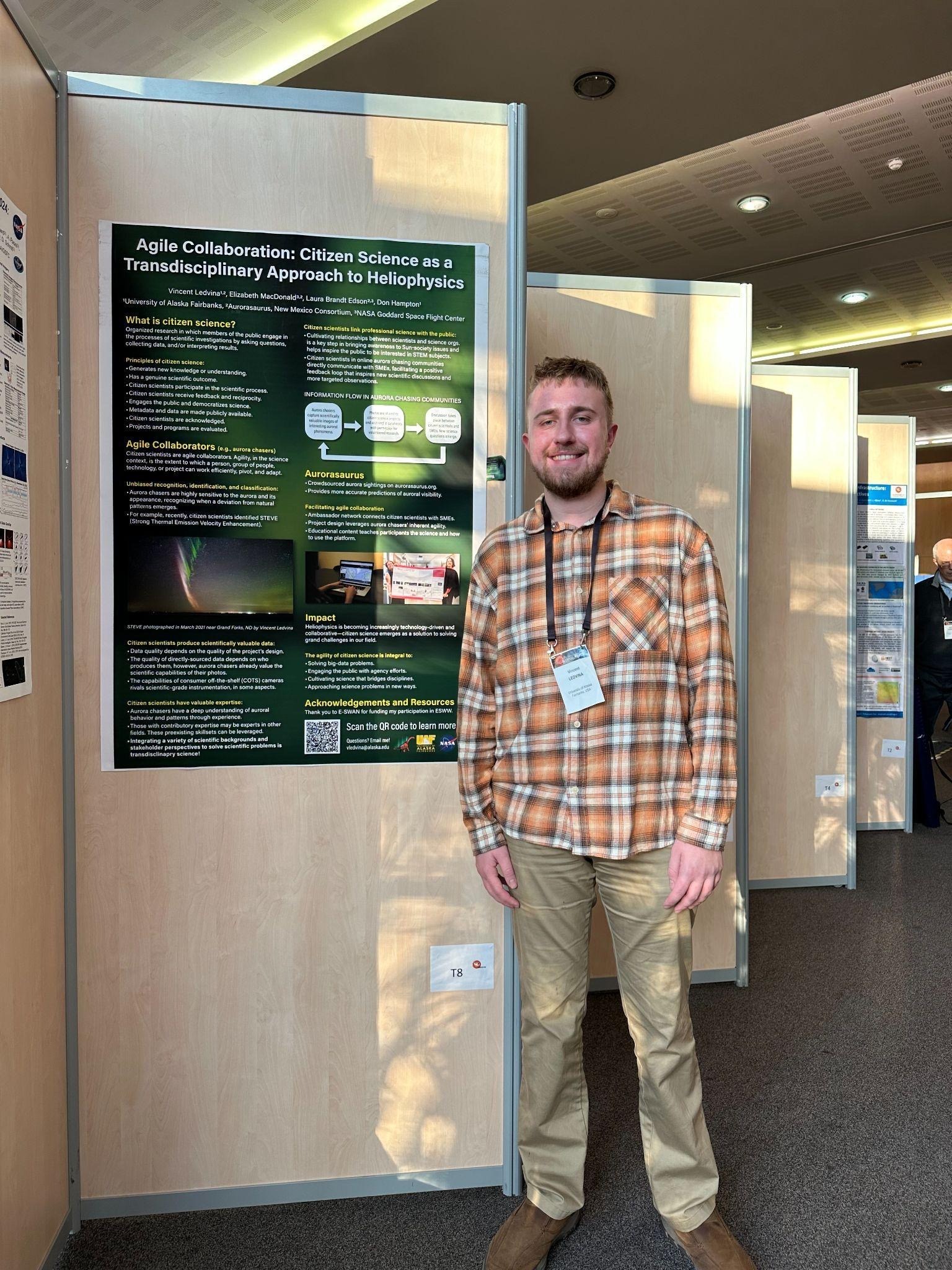
I am a Space Physics Ph.D. student at the University of Alaska Fairbanks, where I study the aurora using a variety of techniques, including citizen science. Citizen science, also known as ‘participatory science’, is when non-research related people contribute to scientific research. This can be facilitated by citizen science projects (e.g., Aurorasaurus or AurorEye), data collection (e.g., Nishimura et al. 2026), or more dynamic collaborations and working groups like the International Space Science Institute’s ARCTICS team. Using citizen science techniques to do my research puts me in a productive but messy part of the literature. A citizen science heliophysics paper might involve space physics, atmospheric science, data validation, human-computer interaction, public engagement, amateur observing communities, and operational space-weather applications. The science is connected, but the literature is often scattered.
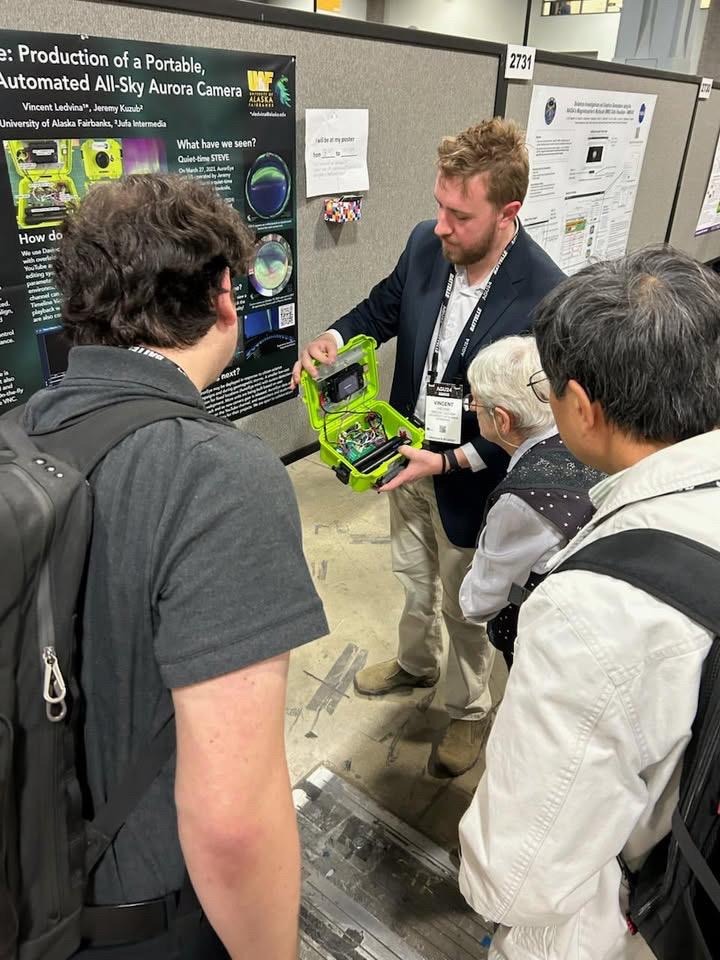
That challenge matters in practical ways. When I am working on a paper or helping plan a project, I want to know how other efforts recruited participants, validated observations, handled data quality, described uncertainty, or connected citizen data to scientific measurements. A traditional keyword search can find individual papers, but it does not always show the connections and relationships (neighborhood) around those papers.
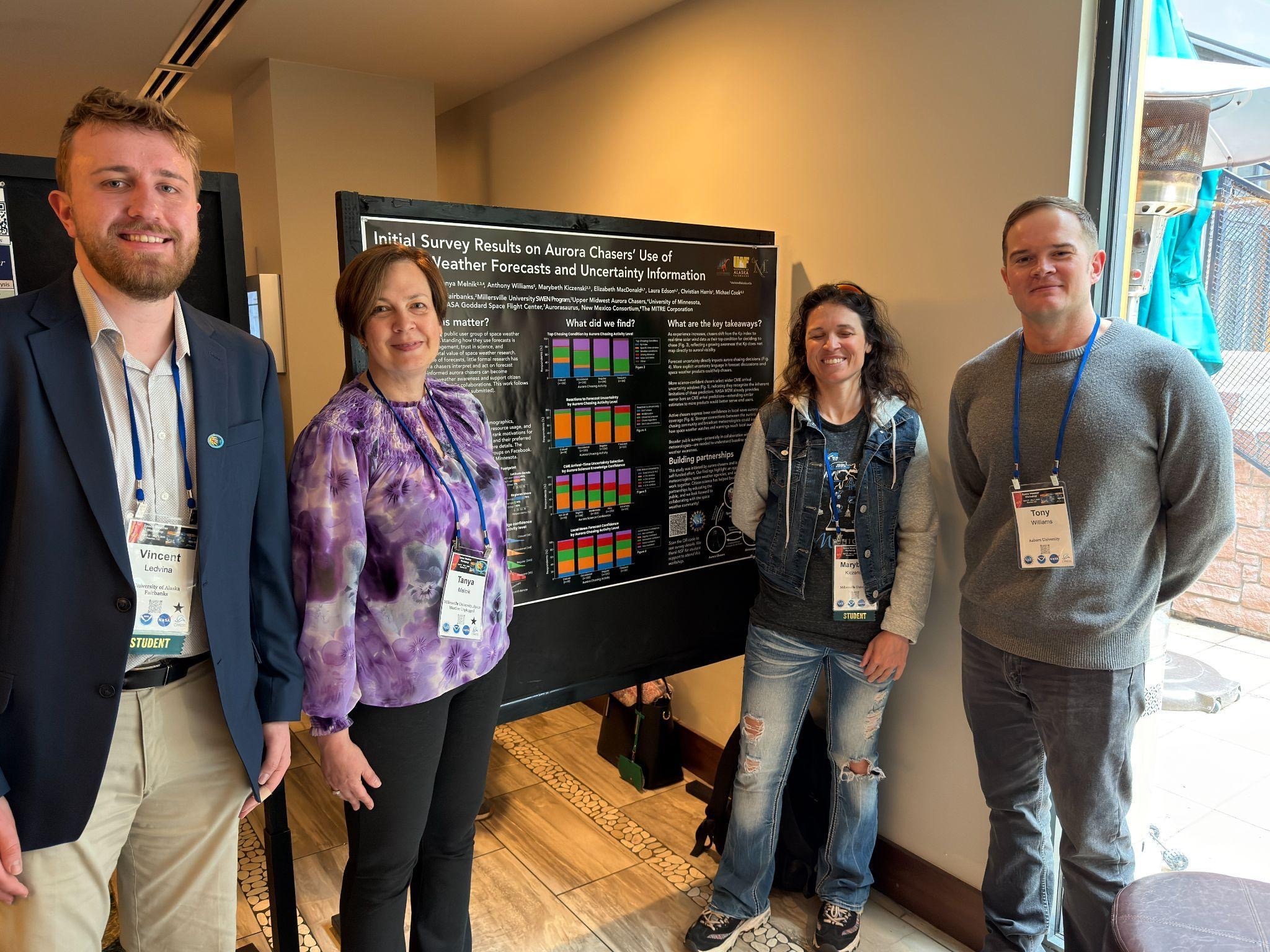
Science Explorer (SciX) is useful because it helps me discover more papers that are relevant and visualize the links between themes in the literature. Built on the NASA-funded Astrophysics Data System (ADS) foundation and expanded across Earth and space science, SciX brings together literature, citations, metrics, and visual exploration tools. For interdisciplinary work, that combination helps me find matching papers and understand how topics are connected.
Starting with one messy query
When I am preparing a new project, the first thing I need to know is whether people have already studied the problem I want to investigate. That sounds obvious, but it is not always easy for a topic that sits between fields. If I only search for the exact words I have in mind, I may miss work that uses a different vocabulary but is scientifically close to the project.
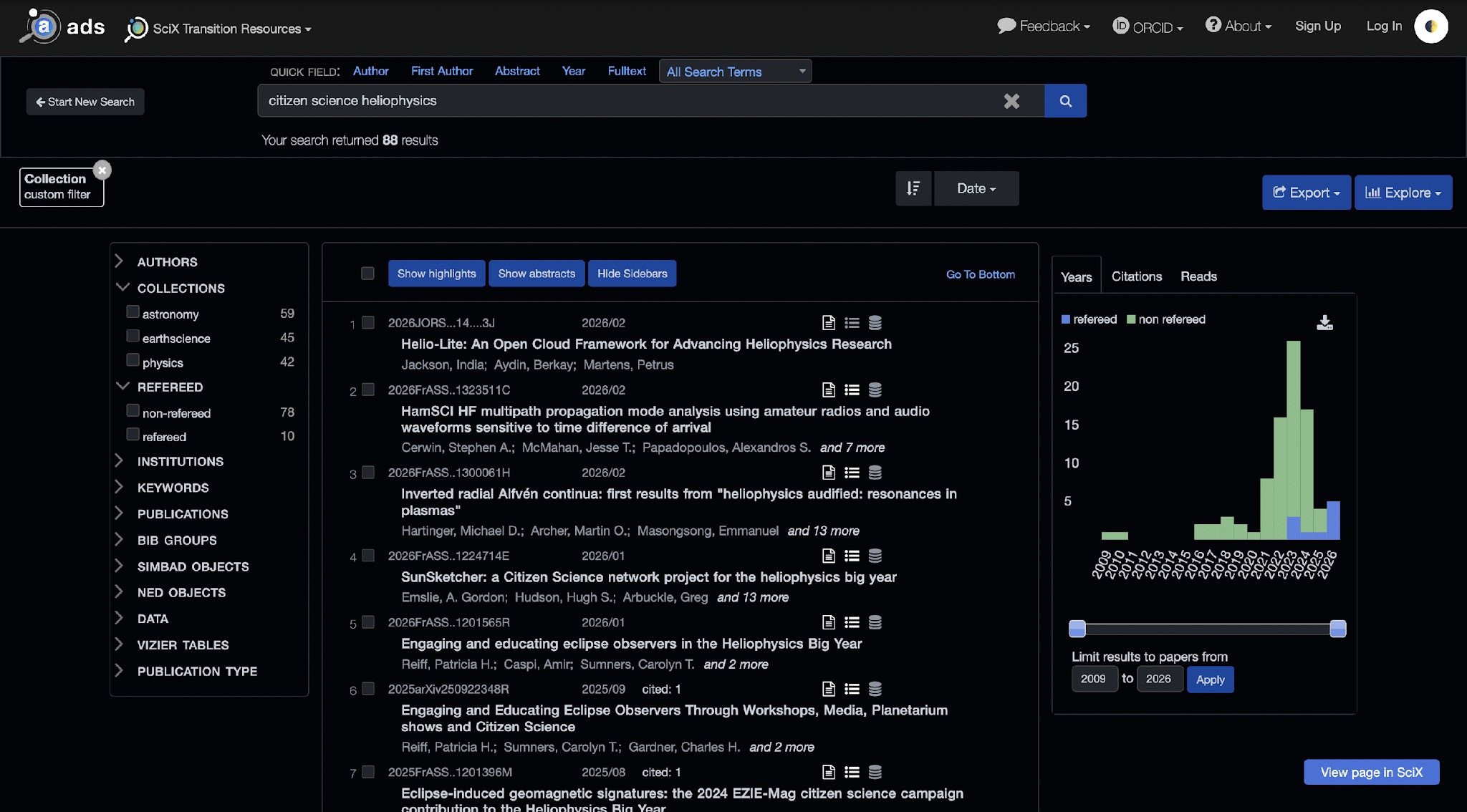
A useful first test is a deliberately messy query: “citizen science heliophysics”. It is broad enough to pull in papers about aurora reports, amateur radio, eclipse campaigns, solar observations, and public participation in space science. It is also broad enough to show why the search interface matters.
In NASA ADS, the query returns a conventional search-result page. That is still useful, especially for a researcher who already knows how to sort, filter, and inspect a literature list. But at this stage of a project, I am usually not only asking how many papers exist but also what papers are closest to my research topic and which path through the literature will get me oriented fastest.
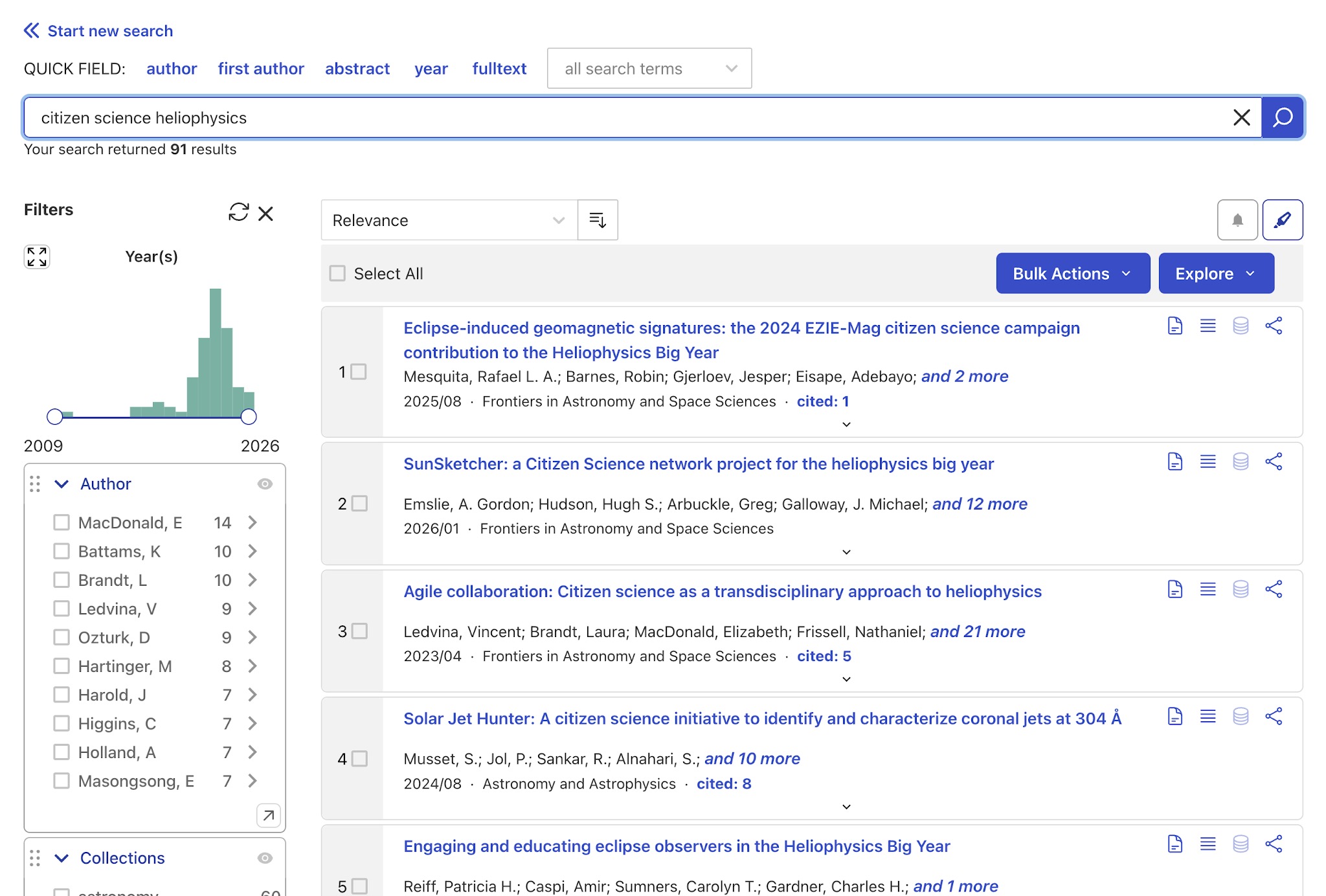
Running the same broad idea in SciX gives me a more useful starting point for this kind of interdisciplinary search. The results page is still recognizable as a search page, but it immediately puts the pieces I care about in the foreground: relevant papers, author facets, collection facets, publication-year structure, and an Explore menu for moving from a list into relationships.
This is the first reason SciX fits the way I actually do literature searches. Before I decide what to read, I want to know whether the field has already researched my question, which communities are connected to it, and which papers look close enough to become anchors for the next stage of the search.
Checking whether the field is moving
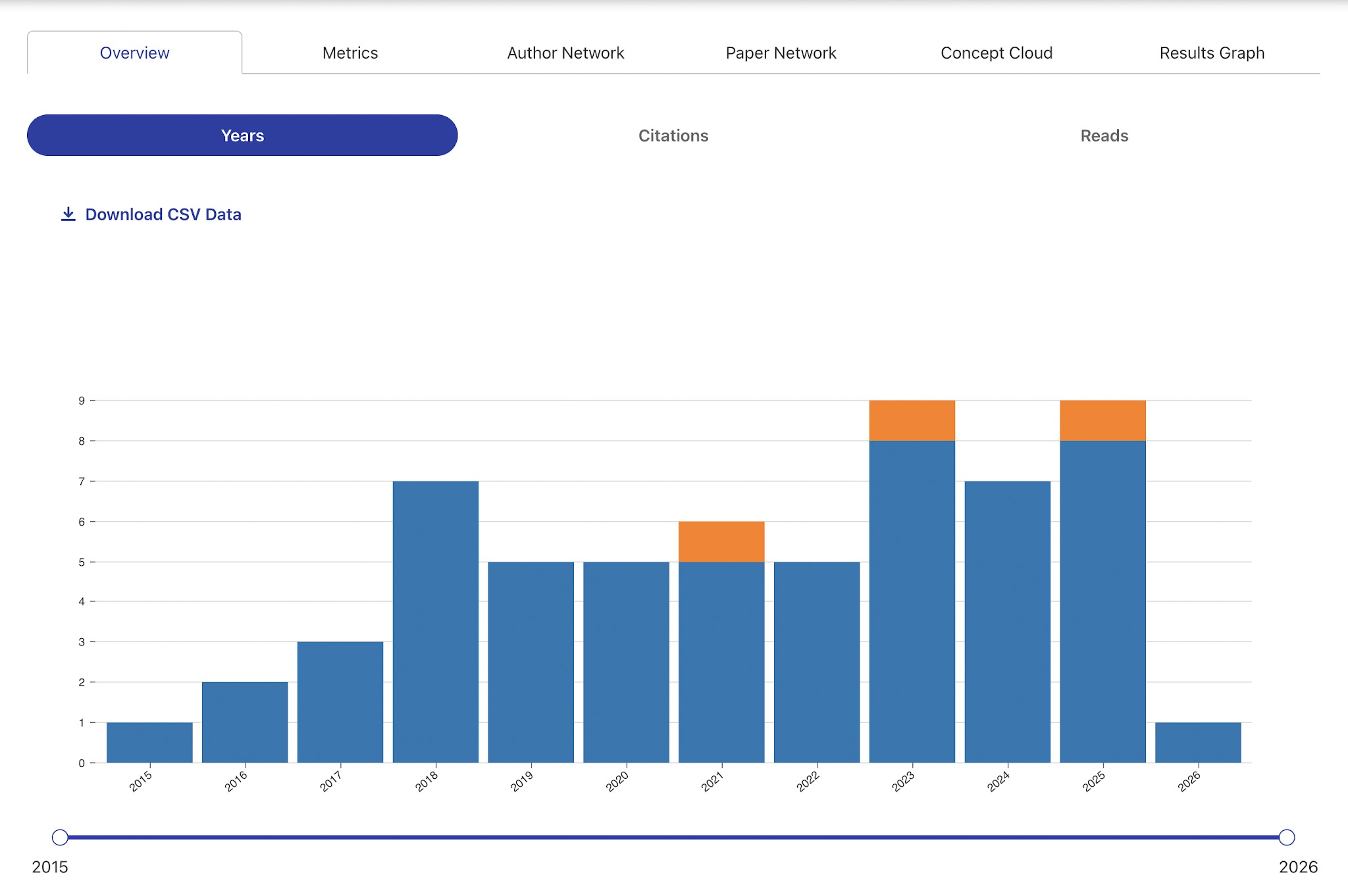
After I know that a topic has a real literature foundation, the next question is timing. A publication timeline can show whether a field is quiet, steadily active, or suddenly getting attention. That context matters for me when I am preparing a project. A spike in papers may point to a new instrument being released, a major observing campaign, a large collaboration, a new technique, or a broader wave of interest that my work can contribute to or benefit from.
For heliophysics citizen science, this is especially important because projects often grow around moments when public observations and scientific needs line up. A major geomagnetic storm, an eclipse campaign, or an organized community effort can create a burst of papers. Seeing that pattern early helps me understand whether I am joining a field with established momentum or helping build one that is still emerging.
The point is not that the timeline answers the science question. It gives me context about when the field became active, whether interest is renewed, and which time periods I should inspect more carefully.
Mapping the people behind the papers
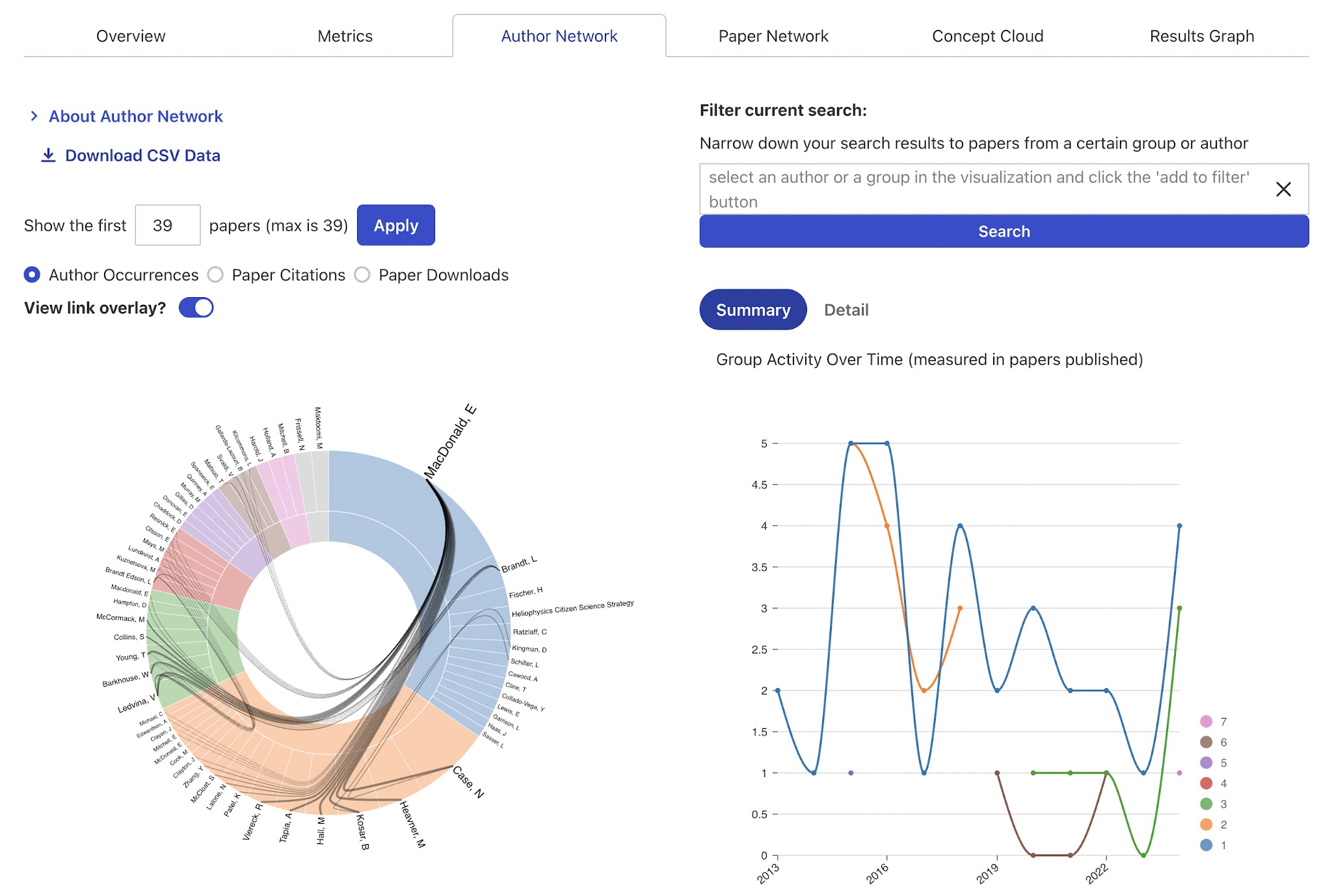
Once I know more about the activity of the topic, I want to understand who is doing the work. The Author Network is useful because papers are not isolated objects. They are written by teams, and those teams often reveal the collaborations, instruments, communities, and methods behind a field.
For a citizen science project, this context lets me see if the same groups of authors appear across related papers and if I can identify research teams that have already handled similar data or developed methods that my project should build on. That helps me decide who to cite, whose work to read closely, and who might be worth contacting or inviting into a collaboration.
This is one of the places where SciX is especially useful for project preparation. It moves the literature search from “Which papers exist?” to “Which communities are shaping this topic?” That helps me decide which papers to cite and understand the field which I am trying to publish in.
Following established projects into their citations
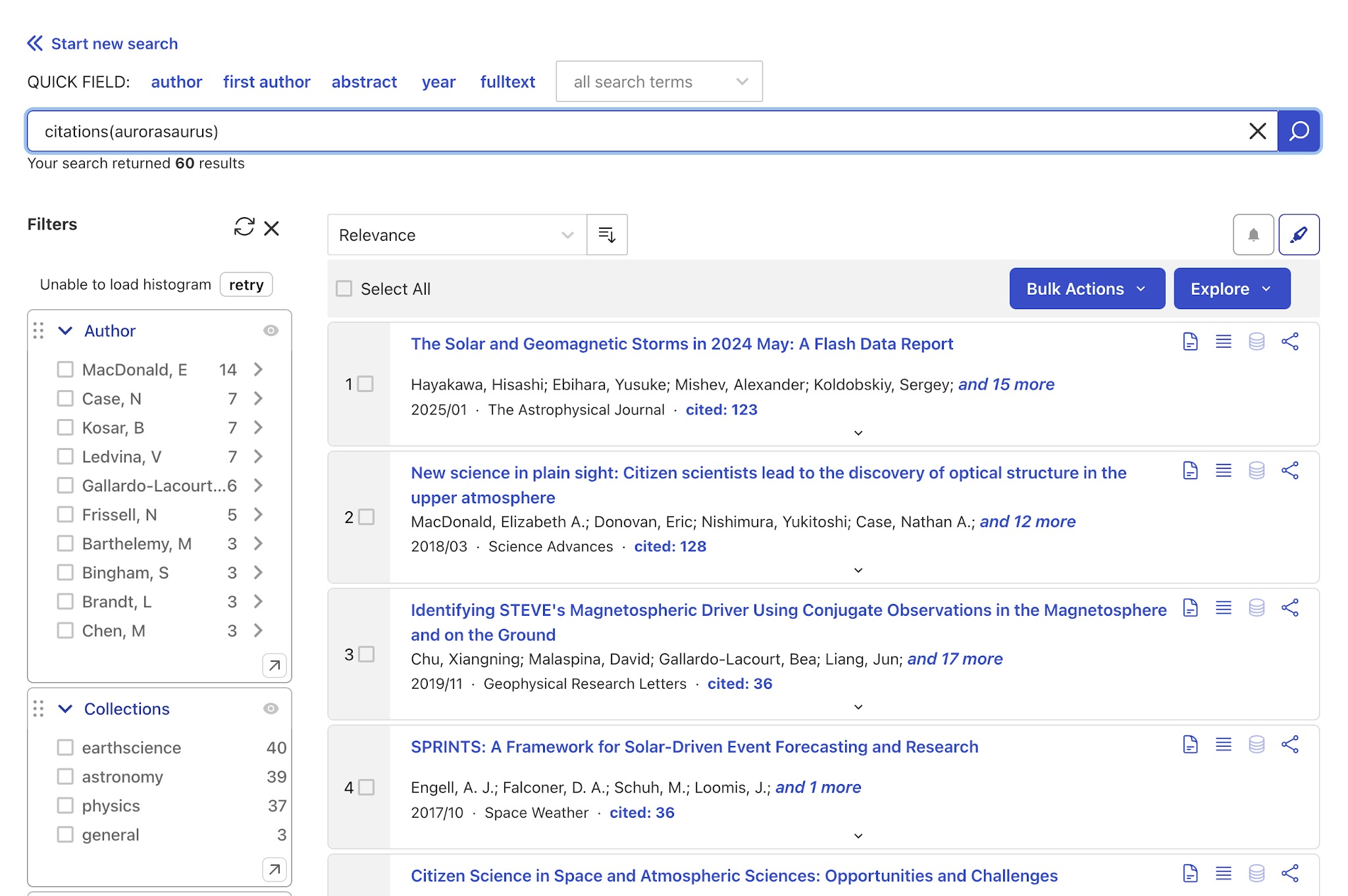
As I get closer to writing, I usually shift from broad discovery to targeted reading. For heliophysics citizen science, one good strategy is to start from a larger, more established project and ask which papers are connected to it. Aurorasaurus is a useful example because it sits at the intersection of auroral science, public reports, data validation, and space-weather applications.
A citation search around Aurorasaurus helps me find papers that I should probably read before I write my own introduction or methods section. Some of those papers may be foundational or show how citizen science observations were validated. Some may connect the project to broader topics of phenomena, such as STEVE (Strong Thermal Emission Velocity Enhancement), specific geomagnetic storms/events, or public-facing observing networks.
This stage is less about collecting every possible paper and more about building a validated reading list. If a larger project has become central to the topic, the papers around that project can show which methods, datasets, and scientific questions the field already treats as important.
A chronological workflow for literature search
For me, SciX is most useful when I treat it as part of a project-preparation workflow. The process looks something like this:
- Start with a messy query that describes the research idea.
- Compare the first results and ask whether the returned papers are actually close to the topic I want to investigate.
- Look at publication and citation patterns over time to see whether the field is emerging, steady, or experiencing renewed interest.
- Use author relationships to identify research teams, established collaborations, and possible people to contact or involve.
- Follow a known project into its citation neighborhood to find papers that should shape the reading list and eventual citations.
- Return to the paper draft with a clearer sense of the field, the people in it, and the work that my project needs to build on.
SciX does not remove the need for careful reading or scientific judgment nor does it decide which papers belong in my literature review. What it does is make the search process more transparent, helping me see the nearby papers, the active collaborations, and the waves of interest around a topic before I commit to a research direction or write the first draft.
For interdisciplinary work, SciX grants a meaningful advantage since discoverability is not only about finding a paper with the right keywords but rather about finding the relationships that make that paper useful. SciX gives researchers a practical way to see those relationships while a project is still taking shape.

Questions or feedback? Contact us at adshelp@cfa.harvard.edu.