 astrophysics data system
Reflections from EAS 2026: The Transition from ADS to SciX and the Future of Astronomy Publishing
Alberto Accomazzi (ADS/SciX PI and Director)
27 Jul 2026
The European Astronomical Society (EAS) Annual Meeting is the largest gathering of astronomers in Europe, and EAS 2026 was no exception. Held from June 29 to July 3 at the SwissTech Convention Center in Lausanne, Switzerland, this year’s semi-hybrid meeting brought together roughly 2,000 specialists — 1,400 in person and 600 online — making it the largest conference dedicated to European astronomy.
From deep dives into dark matter and galaxy formation to the latest on space weather and artificial intelligence, the scientific program was incredibly rich. But for the SciX Team, the best part of the week was connecting directly with the community on the exhibit floor.
Engaging at the Booth: The Evolution to SciX
Our ADS/SciX team, consisting of Alberto Accomazzi (Director), Kelly Lockhart (Tech Lead), and Sergi Blanco Cuaresma (Research Associate), set up shop in the exhibit hall with a primary mission: to chat with users about the upcoming transition from the Astrophysics Data System (ADS) to the Science Explorer (SciX).
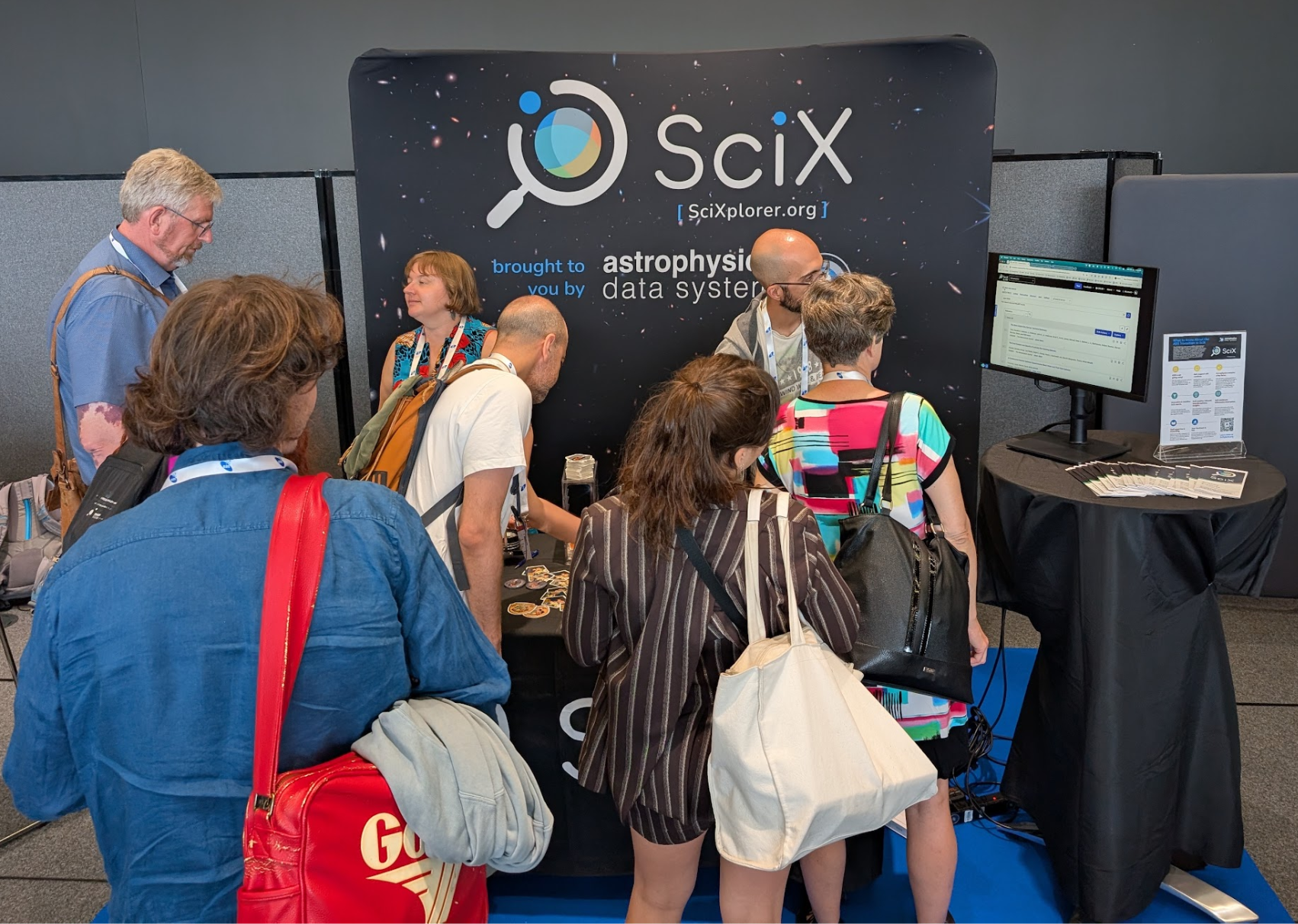
For decades, ADS has been the daily backbone of literature discovery for astronomers worldwide. SciX, the new digital library expanding this same powerful infrastructure across all NASA Science Mission Directorate disciplines, represents the next big leap forward. While ADS has shaped how we find astrophysics research, SciX opens the door to much broader, interdisciplinary discovery.
It’s completely natural for long-time ADS users to have questions when a tool they rely on every day undergoes a major evolution. Hosting a booth at EAS gave us the perfect opportunity to walk researchers through the new interface, answer their questions, and demonstrate how all their existing ADS accounts, settings, and workflows carry over seamlessly.
What the Community is Saying
There’s nothing quite like hearing direct feedback from the people who use these platforms every day. We were thrilled by the positive reactions from researchers trying out SciX at the booth:
“As a PhD student I didn’t use ADS for too long, and when SciX was announced I gave it a try. I noticed that SciX was more polished and user-friendly. It’s also good that you have more content in the database so it’s easier to search for other disciplinary content,” commented Pawel Janas, PhD Student at Maynooth University.
“I am impressed with the new platform and I think it will help junior researchers discover important information about science topics,” said Ivana Bešlić, Postdoctoral researcher at Paris Observatory.
“While the interface is quite similar, the website looks more polished. I was concerned at first about switching links from ADS to SciX, but I’m now reassured to hear that all links will be properly redirected,” said Aymeric Ferec, from University of Pavia.
Highlighting Special Session 44: AI and Open Access
Beyond the exhibit hall, the shifting landscape of literature discovery was a major theme of the scientific program. On July 3, a particular standout was Special Session 44: AI and Open Access in Modern Astronomy Publishing.
This session offered the European astronomy community a vital opportunity to discuss how astronomical journals function in practice, how policies affect authors, and how AI and Open Science are fundamentally transforming our field. What made this session particularly engaging was its format: rather than just a series of lectures, the organizers explicitly prioritized open community feedback, reserving at least 30 minutes in each of the three blocks for in-depth discussions with the audience.
The program brought together an impressive roster of researchers, editors, librarians, data providers, and publishers, divided into three thematic blocks. The first block focused on “Astronomy Publishing Today”. Chaired by Johan Knapen (Instituto de Astrofísica de Canarias), this block kicked off with a town hall discussion on the rapidly evolving publishing landscape, with presentations from Uta Grothkopf (ESO) and David Hogg (NYU). The resulting 70-minute roundtable tackled tough questions, such as whether the community is genuinely better off after years of Open Access publishing, and whether journals should regulate AI or “go with the flow.”
Block 2 focused on “AI in Astronomy Publishing and its Practical Applications”. The session included distinct perspectives from across the ecosystem: an astronomer’s view from Paul Woods (Nature Astronomy), an editor’s view from Marc Huertas-Company (Astronomy & Astrophysics), and an infrastructure view from our own Alberto Accomazzi (SciX).
Block 3 focused on the “Future of Astronomy Publishing”. Chaired by Marc Huertas-Company, the final block explored future trajectories, including alternative peer review models and data publishing. It featured a comparative look at the future through the eyes of an astronomer (Johan Knapen), the Royal Astronomical Society/MNRAS (Liz Baker), and A&A (João Alves).
During the first session panel and his second session presentation, “AI for Astronomers: a View from the ADS,” Alberto Accomazzi highlighted how the SciX infrastructure is evolving to leverage AI and meet the challenges it brings to scholarly publishing. If you weren’t able to attend the session in person, you can view his presentation on Zenodo.
Looking Ahead
Leaving Lausanne, we are more excited than ever about the future of literature discovery. Thank you to everyone who stopped by the booth, shared their thoughts, or attended our sessions. The feedback we gather at events like EAS is exactly what helps us refine SciX into the best possible tool for the global research community.
See you all next year!
Questions or feedback? Contact us at adshelp@cfa.harvard.edu.