 astrophysics data system
What's New
October 2026
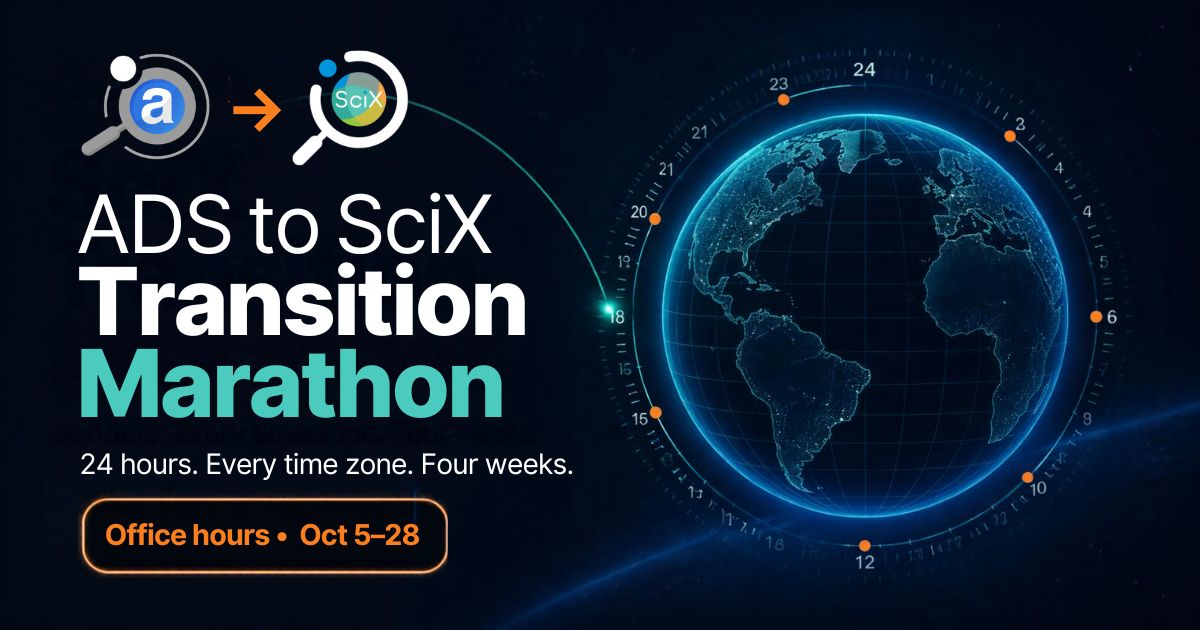
Ahead of the transition from ADS to SciX on 16 November 2026, the ADS/SciX team is going around the clock with a four-week series of online office hours for the astronomy community. Across 24 two-hour sessions, we’ll cover every hour of the global research day at least once, giving ADS users everywhere the chance to drop in, ask questions, test familiar workflows, explore new SciX features, or simply get comfortable with the platform before transition day. Your ADS account, libraries, notifications and settings will move with you, and we’re here to help make the rest of the transition just as seamless. Read the full blog to find a session that works for you and add it straight to your calendar.
The Science Explorer team has been awarded a Smithsonian 2026 Digital Innovation Award. The award honors teams who have demonstrated creativity and innovative thinking in either introducing novel digital solutions or re-imagining existing processes. The award notification from the Smithsonian Office of Digital and Innovation included the citation below:
SciX is a free, open research-discovery platform developed by the Smithsonian Astrophysical Observatory in partnership with NASA that expands the long-running Astrophysics Data System (ADS) beyond astronomy into Earth, environmental, planetary, and space sciences. Rather than simply returning lists of publications, SciX connects papers to the datasets, software, observing proposals, grants, references, and citations associated with them, creating a continually growing knowledge network that helps researchers discover relationships across disciplines.
The expansion has grown the collection roughly 2.5-fold to more than 36 million records, including 15 million Earth Science records, while retaining expert curation and incorporating AI and machine-learning tools to classify and connect information at this much larger scale. Its reach is substantial: the underlying ADS/SciX platform recorded 11.6 million engaged research sessions in FY25, representing more than 30,000 per day from researchers in 100+ countries, and users followed 1.72 million links from publications to associated data products in a single quarter. SciX has extended a research infrastructure that astronomers have relied on for decades to many more scientific communities and provides a free, expertly curated and interconnected body of scientific knowledge that can serve as a trustworthy foundation for both human research and emerging AI-assisted scientific discovery.
SciX Project Scientist for Earth Science, Dr. Anna Kelbert, is attending the Research Data Alliance (RDA) 27th Plenary Meeting in London, UK that runs October 6th-8th, 2026. She will introduce SciX and answer questions from the audience at a session on the Perspectives on Earth, Space and Environmental Science Data: Connections, FAIR Practices and Resilience on Tuesday, October 6th. She will stay to present a poster on Fostering cross-disciplinary dialogue and credit attribution practices through Science Explorer in the evening, and will be available for the rest of the workshop for networking and to answer any questions on SciX.
 SciX at GSA Connects 2026
The SciX Team will be in Denver for the Geological Society of America’s GSA Connects 2026 from October 10th-14th. Suze and Jeff will be at Booth #736. Pop by to learn about how SciX can help you, get a demo of the platform, pick up some cute swag, and represent your most sciencey self in our pop up photo booth!
Website and API Releases
- [new] Added new solr fields to the comprehensive search term list; 'has', 'planetary_feature', 'planetary_feature_faciet_hier_3level', 'uat', 'uat_facet'
- [improved] Updated What’s New layout to show by year
- [improved] Updated the Team page
- [improved] Updated the Advisory Board page and blog roster
- 781k new records and 1.01M new citations.
- We have recently added approximately 400K entries for datasets from more than 50 trusted repositories such as NASA, USGS, NCAR and more. By indexing these datasets, which all have DOIs, we will be able to connect them to papers which cite or mention them, helping connect all pieces of the publication cycle of a research work.
Development details
- API Gateway
- v1.2.9 - [improved] Added access modality header to API traffic report for improved behavior tracking
- Nectar
- v0.50.2 - [new] Added Search Modifier Bar with ADS Compatibility mode
- Scan Explorer
- v1.0.13 - [fixed] Various bugs in the functionality: stopped the content search crashing on a stop word; pagination error reporting; clear the cache when a single article or page is updated; etc.
- v1.0.12 - [improved] Raised per-user rate limits from 300/day to 5000/day
- Scan Explorer UI
- v1.0.9 - [fixed] Return link sending SciX users to ADS
- Solr
- v96.5.3 - [improved] Schema changes
- [improved] Centralize back-to-results navigation
- [improved] Condense classic form UI
- [improved] Updated the tour of the SciX interface to include ADS-specific language
- [fixed] Switch to Astrophysics on Classic/Paper forms
- [fixed] Resolve object queries before visualization requests
- [fixed] Stop “Record Not Found” flash; distinguish error from not-found
- [fixed] Keep paper limit and CSV reachable on empty viz
- [ops] Deployed Browse mode in internal testing mode
September 2026

The ADS/SciX team had a busy time interacting with scientists attending the 46th COSPAR Scientific Assembly that took place on 1-9 August in Florence, Italy. Daniel Chivvis and Alberto Accomazzi demonstrated how the upcoming transition from ADS to SciX this fall will better serve the broad, multidisciplinary space science community represented at COSPAR—spanning astrophysics, planetary science, heliophysics, and Earth observation.
After going through a demo of the SciX platform, pictured ADS user Raj Mal Jat, PhD student from Central University of Rajasthan in India, commented “I'm excited to switch from ADS to SciX.” Dagmara Stasiowska, a Life Scientist postdoc from the University of Krakow, was impressed by the author network visualizations and commented: “I see the potential of SciX to increase the diversity of the researchers we are collaborating with.” Have you explored the new features available in SciX yet? Start browsing our quick start guide today!
 The Lowdown on IEEE/IGARSS
The SciX team chatted with Earth observation and remote sensing researchers at the IEEE International Geoscience and Remote Sensing Symposium (IGARSS) 2026 in Washington, DC. For most of them it was a first introduction, and their reactions were even better than we imagined. Rui Cao, Assistant Professor at the Hong Kong University of Science and Technology (Guangzhou), said, "I found the service and platform very useful for researchers, and it is non-profit. Surprisingly, I found that the Abstract Service [from Harvard] is also provided by them. I would recommend the service to my colleagues and students.”
Anshula Dhiman, a PhD student at Cleveland State University, said "I really liked how it shows all the metrics related to an author I'm interested in - seeing everything about a research article, from references to the projects and datasets associated with it." To learn more about the features that got the remote sensing crowd excited at IEEE-IGARSS, head to scixplorer.org.
The Astro Society held a three-day virtual conference to celebrate 250 years of astronomy in the United States, and Dr. Jennifer Lynn Bartlett and Dr. Suze Kundu from the SciX team ran a workshop introducing people to SciX. Among other things, Jennifer led the group through the research adventures of Nancy Grace Roman, ahead of the launch of the space telescope named after her. Some participants were existing users of ADS and found the user interface of SciX pleasantly familiar, while the majority were brand new to the SciX platform and were blown away by the ease of search and discovery, and the in-built visualization features.

 Digitizing Decades of Mercury
Since 1972, Mercury magazine has served as the Astronomical Society of the Pacific's (ASP) public voice, translating cutting-edge astronomical research into stories anyone could follow. Across more than three decades of issues, Mercury chronicled the space age as it happened in the words of the scientists and science writers who lived through it.
While issues from 2007 onward have long been available online, everything printed between 1972 and 2007 has existed only on paper, tucked away on library shelves and effectively invisible to today's researchers, educators, and space enthusiasts. A new initiative from the ASP and Astrophysics Data System aims to close that 35-year gap: digitizing every issue from this period and making it freely searchable through the ADS and Science Explorer (SciX). Once complete, the entire run of Mercury will be permanently preserved, fully text-searchable, and openly accessible to anyone, anywhere — no subscription or institutional affiliation required. Learn more about the Mercury digitization initiative.
Website and API Releases
- [new] Added a new page describing 'Initiatives' the team participates in
- [improved] Updates to the What's New page formatting
- 163k new records and 11.32M new citations.
August 2026
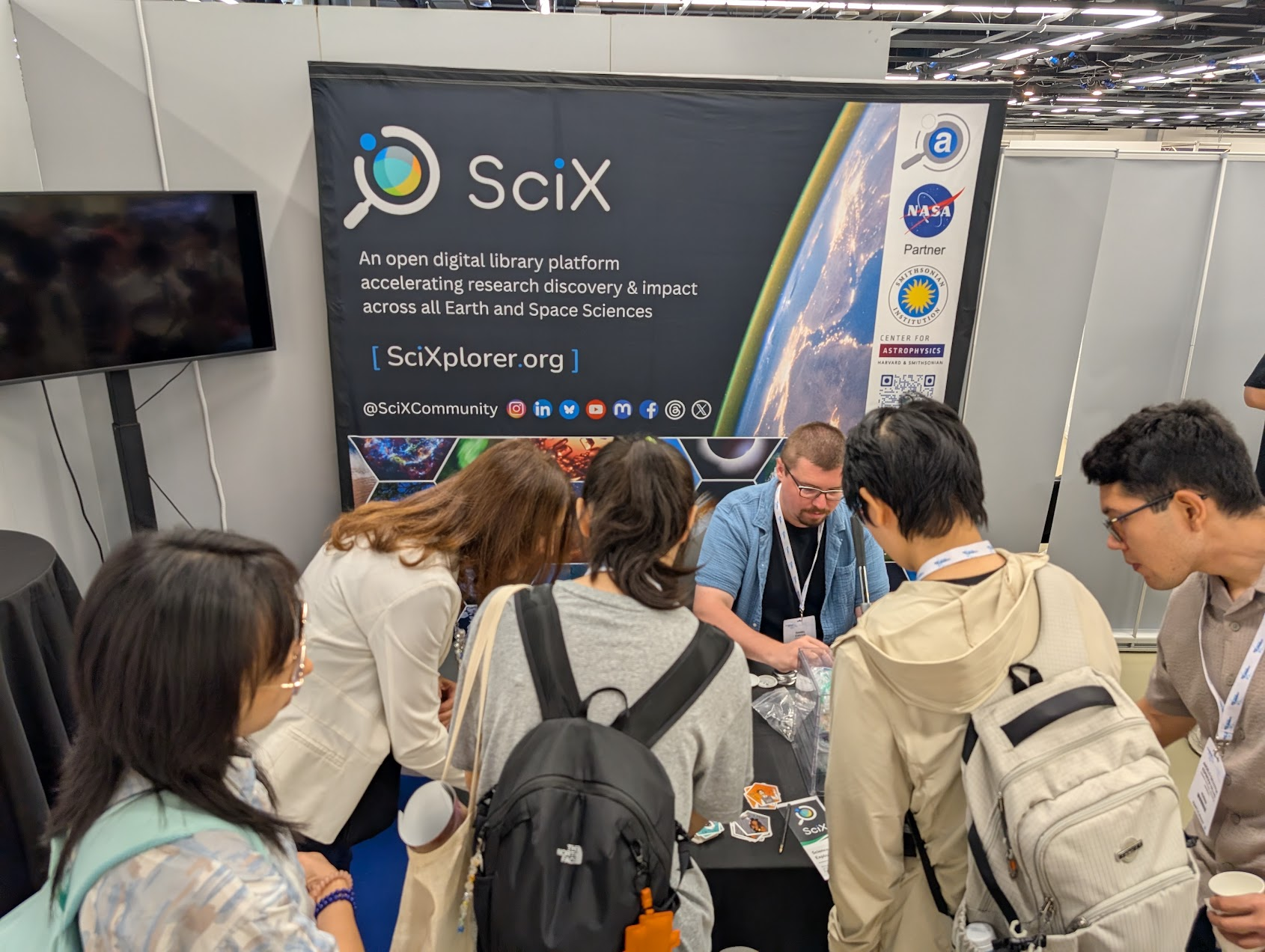 We’re At COSPAR!
ADS/SciX team members Alberto Accomazzi (Director), and Daniel Chivvis (Digital Librarian) are excited to be on the ground at the 46th COSPAR Scientific Assembly in Florence, Italy! Stop by Booth #28 to learn how our upcoming transition from ADS to SciX this fall will better serve the broad, multidisciplinary space science community represented at COSPAR - spanning astrophysics, planetary science, heliophysics, and Earth observation. Come explore the expanded SciX platform, ask questions about the rollout, and grab some exclusive, fresh-off-the-press SciX swag.
Whether you're a longtime ADS power user or just discovering our tools, we'd love to meet you and hear how we can support your specific space research needs.
Alberto Accomazzi is also participating in Session PSW.4 (FAIR Infrastructure and Open Science) taking place on Wednesday, August 5th, 9:00-10:30am CET with a presentation titled “The Science Explorer: An Open Science Discovery Platform in the Earth and Space Sciences.”
Join the SciX team at the IEEE International Geoscience and Remote Sensing Symposium (IGARSS) 2026 in Washington, DC from 9th to 14th August. Stop by Booth #111 to meet the team, see how SciX is helping researchers discover and connect research across the Earth and space sciences, and explore the latest platform features. Whether you're already using SciX or are curious to learn more, we'd love to chat, answer your questions, and hear how we can better support your research. See you there!
The NASA Science Data Team has released a video of a tutorial by PI Alberto Accomazzi on how SciX libraries can help users manage research portfolios and track research trends. Demonstrating the scientific ROI (return on investment) of research programs, missions, and facilities requires a robust link between funding and the resulting scientific output. SciX offers a comprehensive ecosystem for Program Officers to automate the tracking, curation, and public dissemination of these bibliographies.
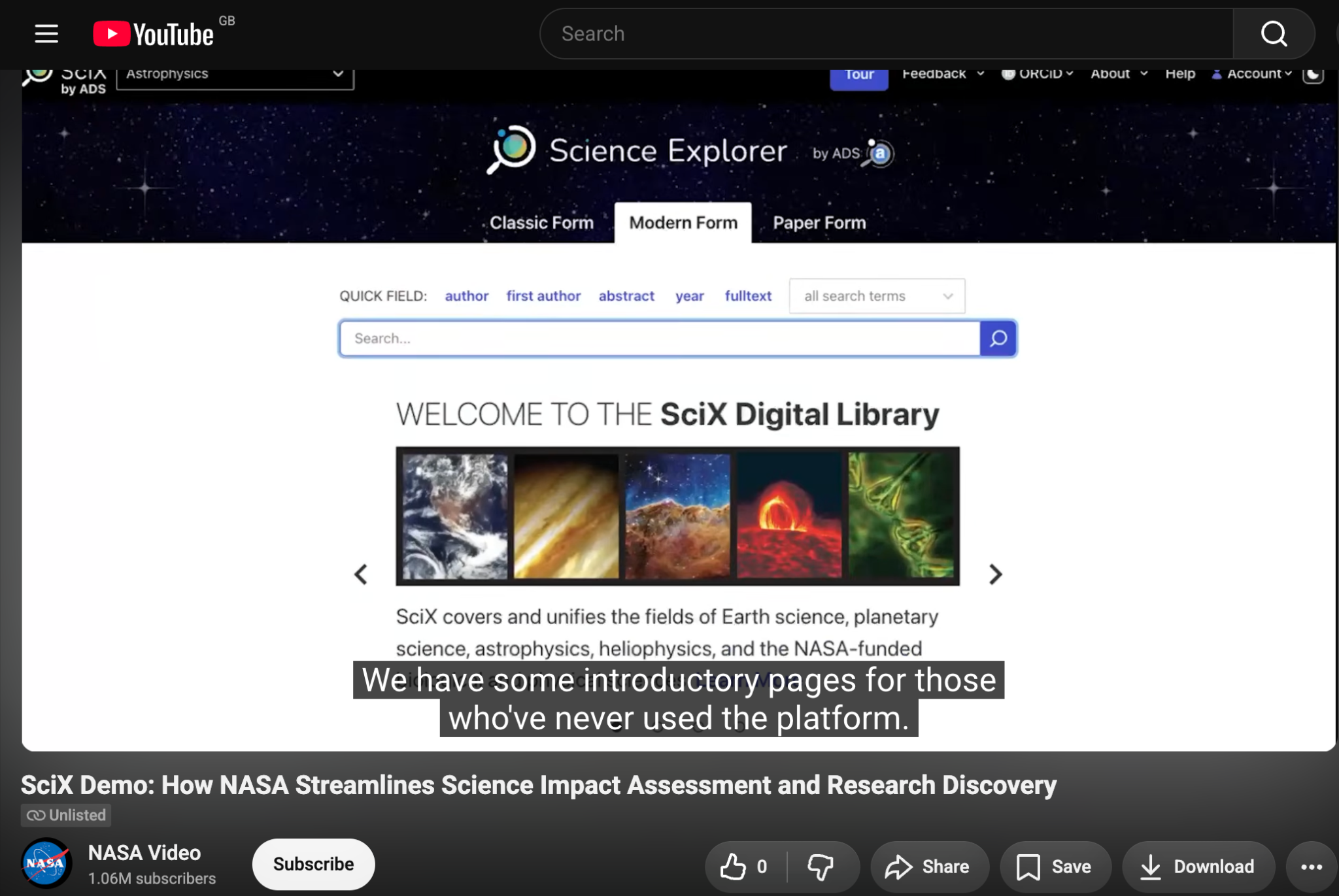
The presentation demonstrates how SciX libraries serve as a centralized hub for managing research portfolios, allowing users to aggregate papers linked to specific missions, facilities, datasets, software, and grants. It explores advanced features tailored for institutional workflows, including: collaborative curation (managing bibliographies across teams), public sharing (leveraging public libraries and the SciX API to integrate publication lists directly into project websites or annual reports), and expertise mapping (utilizing citation networks to identify qualified peer reviewers and track research trends).
SciX has significantly expanded its support for open access by identifying and adding millions of links to freely available versions of publications from PubMed Central and Europe PMC.
Learn how these enhancements make it easier to discover and access openly available research through SciX - Read more here!
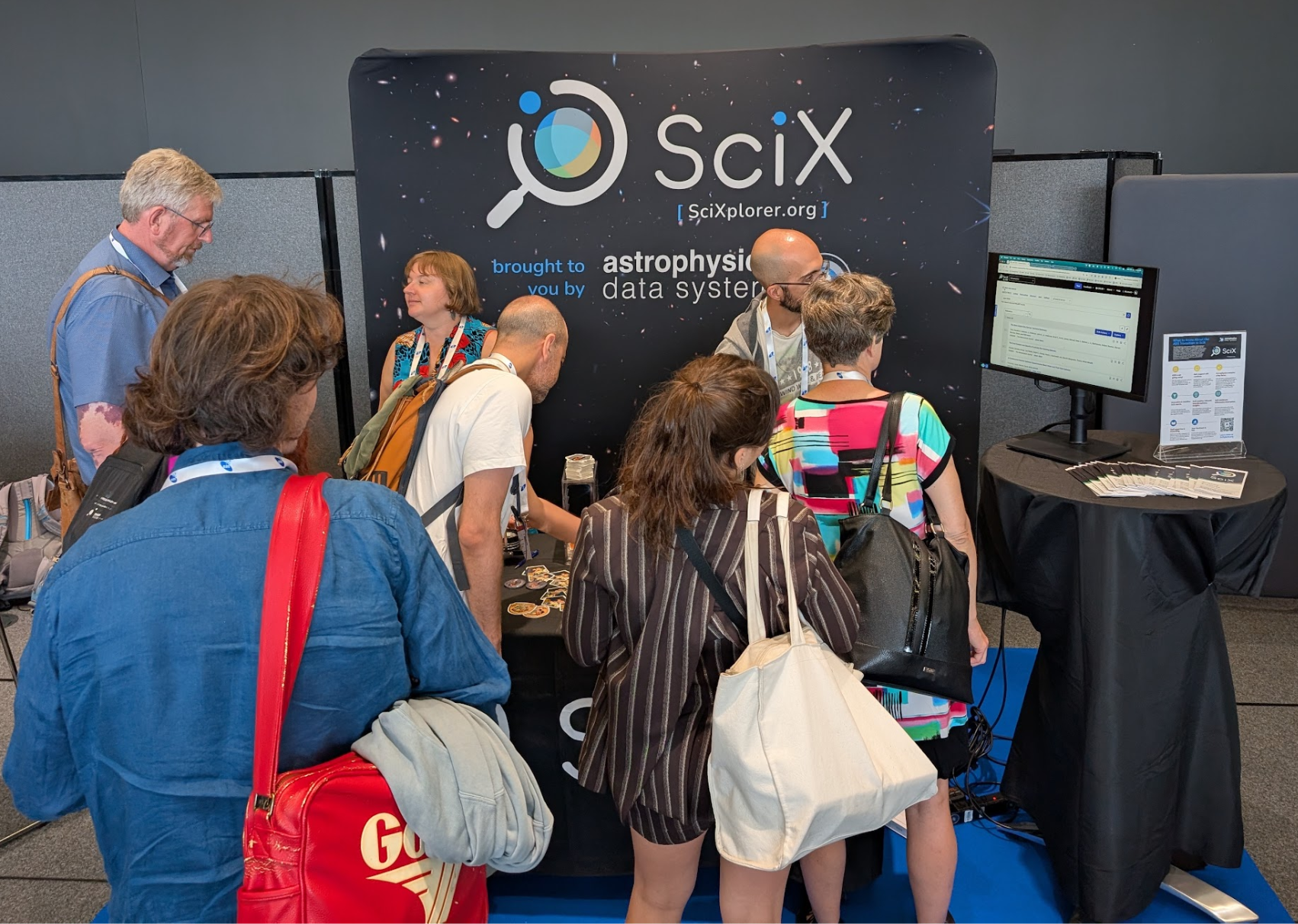
Our team recently returned from the European Astronomical Society (EAS) Annual Meeting in Lausanne, Switzerland! It was fantastic to connect directly with the community at the ADS/SciX booth, where we walked researchers through the upcoming transition and demonstrated SciX's expanded, interdisciplinary capabilities. We were pleased by the positive reception, with users praising the platform's polished interface and seamless redirecting of legacy ADS links.
Beyond the exhibit floor, the evolving landscape of literature discovery was a major theme of the conference. A notable highlight was Special Session 44 on "AI and Open Access in Modern Astronomy Publishing," which featured a panel presentation by our Director and PI, Alberto Accomazzi, “AI for Astronomers: a View from the ADS”.
Read the full blog post to see user testimonials and learn more!
Website and API Releases
- [new] EAS 2026 Recap blog
- [new] SciX Open Access blog
- 421k new records and 8.09M new citations.
- Over 70k PhD theses newly indexed! We're continuing to expand our PhD Thesis collection, making more graduate research easier to discover and access. Can't find your thesis yet? We'd love to include it—submit it through our Missing Record form, and we'll review it for addition to SciX.
Development details
- Metrics Service Releases
- v1.2.0 - [fixed] Convert metrics id column to use BIGINT, increasing support of more values
- Nectar Releases
- v0.49.3 - [fixed] Encoded DOI/OpenURL special characters to fix broken links
- [fixed] Ensure the second-order operator queries (trending, reviews, useful, similar) sort by score instead of user preference
- [improved] Show Google Scholar tags by defined set of doctypes
- [improved] UAT facet field improvements
- [improved] Extended the width discipline mode notifier
- [improved] Removed ‘PAID’ tag on full text sources and updated file icons
- [improved] Add volume and page in search result items
- [improved] Replicate historical literature page
July 2026
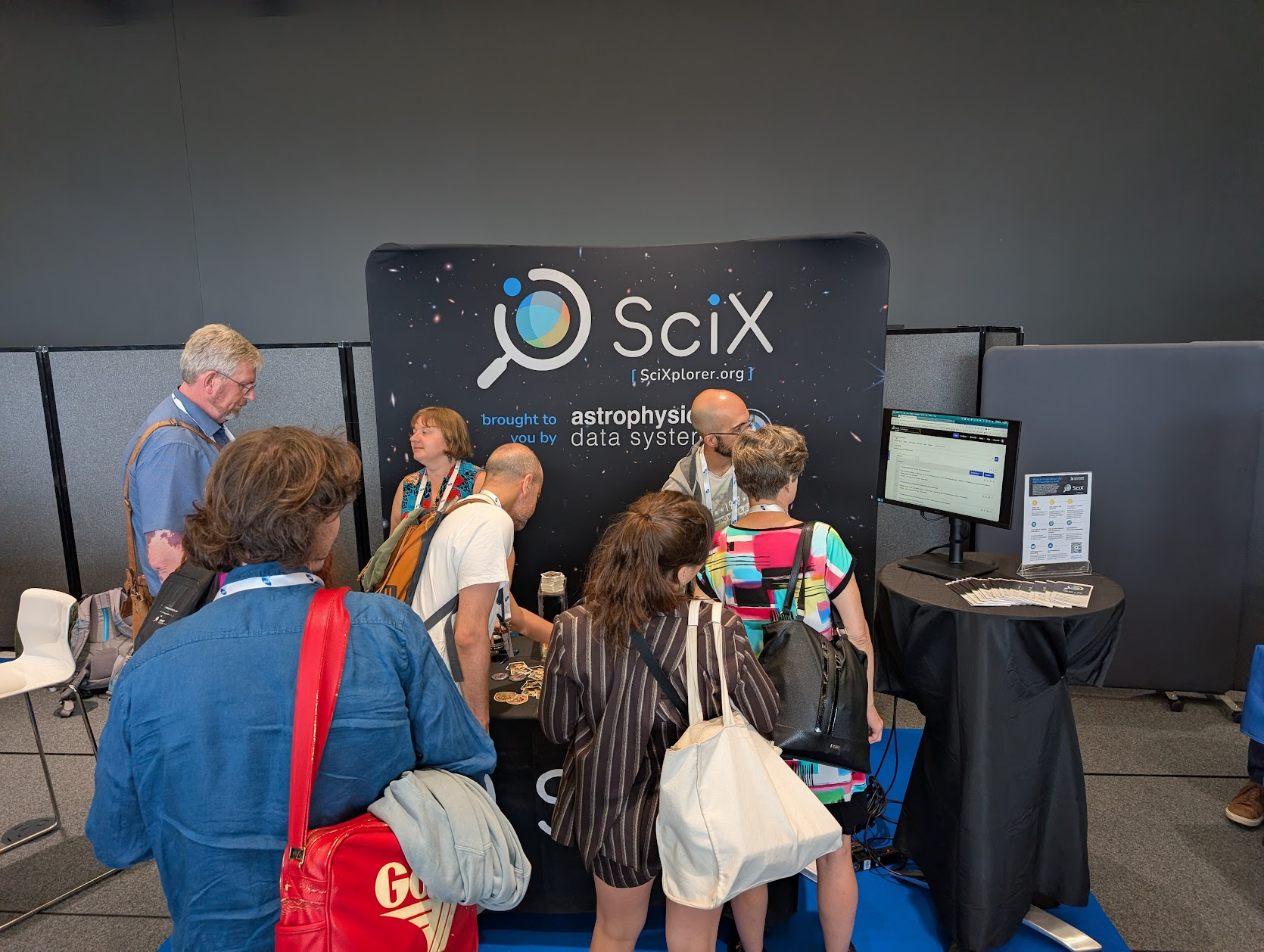 Chat with us at EAS today!
ADS/SciX team members Alberto Accomazzi (ADS PI), Kelly Lockhart (ADS Tech Lead), and Sergi Blanco Cuaresma (ADS Research Associate) are staffing the SciX exhibit booth at the European Astronomical Society Annual Meeting taking place June 28-July 3 in Lausanne, Switzerland. Visit booth #17 to learn more about the transition from ADS to SciX taking place this fall and explore further the SciX platform. Most importantly, help yourself to a range of new SciX logo items fresh off the press. Whether you're a longtime user or just learning about SciX, we'd love to meet you and hear about your research needs.
Alberto Accomazzi is also participating in Special Session 44, “AI and Open Access in modern astronomy publishing” which takes place on Friday, July 3rd. He will be a panelist in block 1 (“Astronomy Publishing Today”) and a speaker in block 2 (“AI in Astronomy Publishing and its Practical Applications”), providing an ADS perspective on the use of AI to support astronomy research. We hope to see you there!
The ADS and SciX teams will be at the 46th COSPAR Scientific Assembly in Florence, taking place August 1-9, 2026. The assembly will bring together thousands of scientists, engineers, and space agency representatives for over 150 scientific sessions dedicated to sharing the latest advancements in space exploration, planetary science, and climate monitoring. ADS/SciX team members Alberto Accomazzi and Daniel Chivvis will be staffing the SciX booth for the duration of the meeting and Alberto will give a solicited talk about SciX in the Fair Infrastructure and Open Science Session on Wednesday, August 5th.
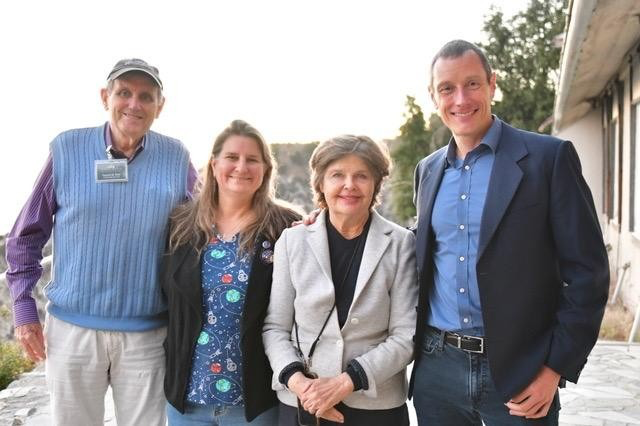
Project scientist for astrophysics Jennifer Lynn Bartlett (2nd from left), accompanied (Harlow Shapley Project; 2nd from right) to Gabriele Vajente’s (LIGO; right) “Talks + Telescopes” presentation about Gravitational Waves at Mt. Wilson on June 20. Sam Hale (left), grandson of George Ellery Hale, is president of the Mount Wilson Institute, which took over management of the facility from the Carnegie Institute of Washington in 1989. Deborah is the granddaughter of Martha and Harlow Shapley. Harlow worked at Mt. Wilson from 1914 until 1921. During this period, Martha gave birth to their first three children and published her first 14 astronomical papers, including four first-author papers in the Astrophysical Journal or Publications of the Astronomical Society of the Pacific. Bartlett is helping Deborah prepare a biography of Martha Shapley.
Website and API Releases
- [new] Added AI policy
- [new] Updated and reformatted the bibgroups page for readability
- 168k new records, and 12.9M new citations.
- 50K theses from SISSA, MIT, Caltech, Rice, UChicago newly indexed
Development details
- Journals Database Releases
- v1.3.10 - [improved] Modified the table that tracks the history of journals to identify predecessor and successor journals by ISSN and coden in addition to bibstem
- Nectar Releases
- v0.48.5 - [improved] Set icon button size
- Solr Releases
- v96.5.2 - [ops] Improved performance from query memory allocation
- Solr-Service Releases
- v1.1.7 - [ops] Add logging for allocation data provided by Solr
- [fixed] Bug affecting list components in Feedback Forms
- [fixed] Make mention and mention_count optional
- [fixed] Prevent reverting user format change when navigating to Export Formats
- [ops] Auto-populate int/float fields so that new fields are automatically recognized
June 2026
SciX is excited to exhibit at the European Astronomical Society Annual Meeting 2026, June 28-July 3 in Lausanne, Switzerland. Visit our booth to explore the SciX platform, see new features in action, and chat with our team about tools that help make scientific research more discoverable and accessible. Whether you're a longtime user or just learning about SciX, we'd love to meet you and hear about your research needs.

Summer AAS meetings are smaller, quieter, and in some ways make for better conversations than the larger winter meetings. If you will be in Pasadena June 14-18, look for Jennifer Lynn Bartlett, Project Scientist for Astrophysics. Although we will not have a booth, she will be presenting and conducting oral history interviews. She would be delighted to talk to you about the transition from ADS to SciX or anything else astronomical (or not, she can be rather chatty).
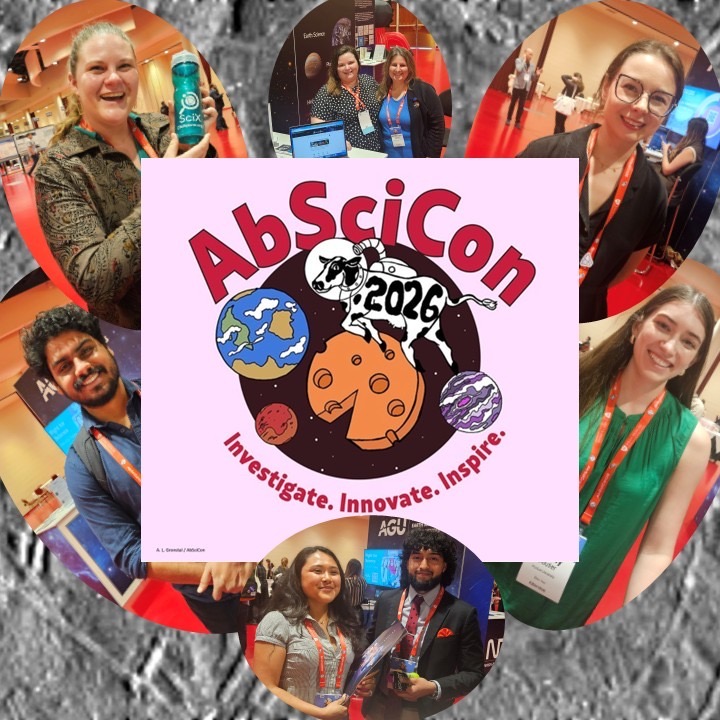 AbSciCon 2026 Recap
SciX was proud to exhibit at AbSciCon 2026, showcasing our platform to the vibrant astrobiology research community. If you missed us, you can find our iPoster “Science Explorer (SciX): Supporting Open and Interdisciplinary Science” or the other files on the Science Explorer Community on Zenodo.
The conference provided an excellent opportunity to connect with scientists, educators, students, and information professionals, many of whom visited our booth to explore SciX's tools and services. We enjoyed meaningful conversations, live platform demonstrations, and valuable feedback from attendees. The strong interest and engagement we received reinforced the importance of discoverability and access within interdisciplinary scientific research.
We look forward to building on the connections made at this year's meeting and supporting the interdisciplinary astrobiology community wherever you are. For more about the meeting and astrobiology content in SciX, read the full meeting summary.
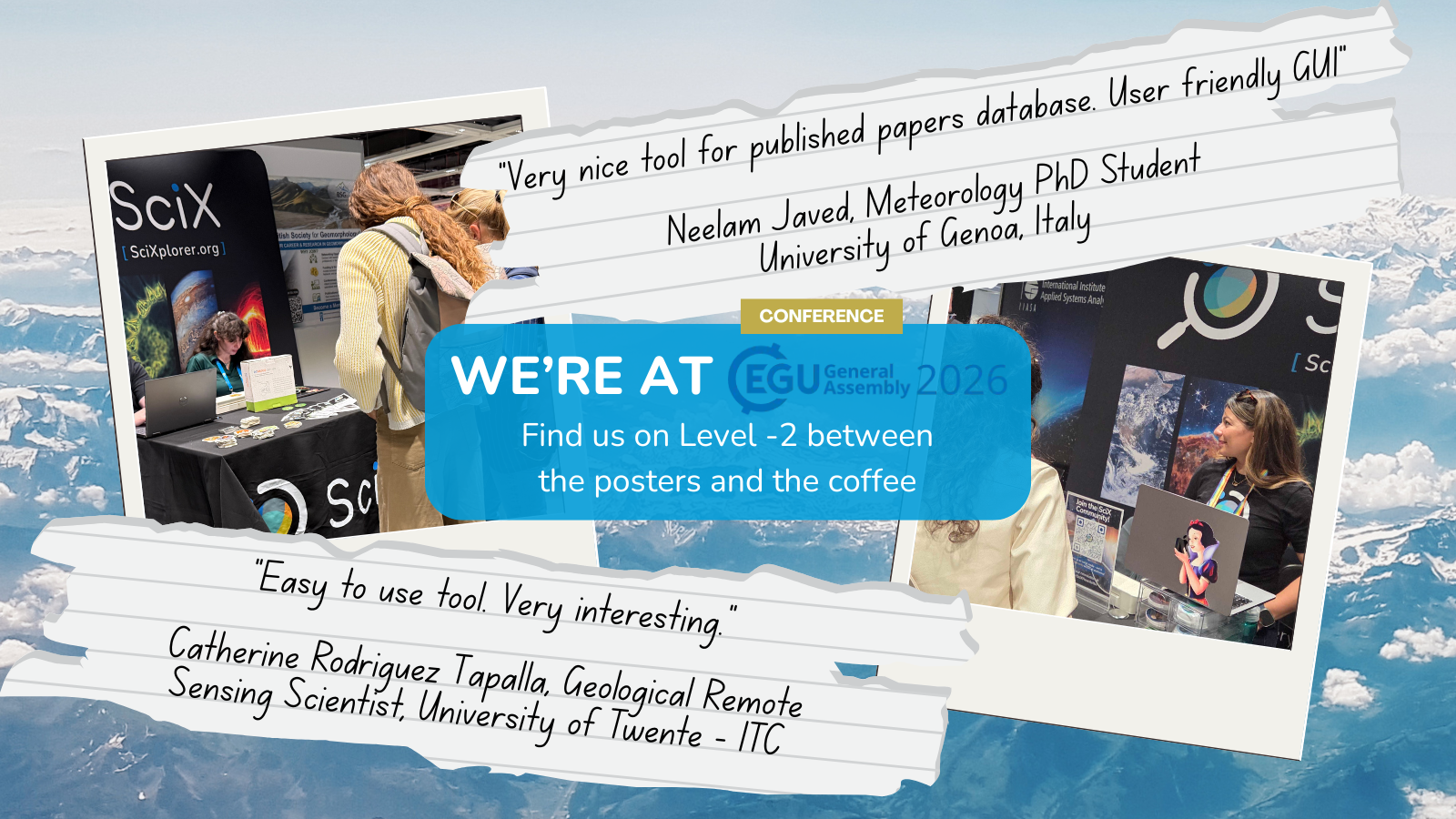
Talks? Check. Posters? Check. Booth demos and conference swag? Also check. But our biggest takeaway from EGU 2026, held in Vienna, Austria in early May 2026, was the enthusiasm of the researchers who stopped by to explore SciX. Rather than writing a traditional conference recap, we're handing the microphone to scientists from across the globe who shared their thoughts on SciXplorer, research discovery, and the future of connected science. Read on to hear what they had to say.
Studying the aurora through citizen science means working across space physics, atmospheric science, public engagement, data validation, and more. In this month's guest blog, SciX Lead Ambassador Vincent Ledvina explains how SciX helps him make sense of this interdisciplinary landscape, revealing the connections between papers, authors, projects, and research communities that traditional literature searches can easily miss. It's a fascinating look at how modern research discovery works when science refuses to stay neatly within disciplinary boundaries. Read the blog post here!
Website and API Releases
- Updated the SciX Team photo
- 181k new records, and 5.7M new citations.
Development details
- Bumblebee Releases
- v1.11.0 - [ops] Integrated FingerprintJS Pro visitor header for bot detection
- v1.10.16 - [improved] increased highlight analyzer limit to 1M
- v1.10.15 - [ops] dependency updates
- v1.10.14 - [improved] Update ORCID work types to match current doctypes
- Solr Releases
- v96.5.1 - [fixed] Removed invalid import
- Solr-Service Releases
- v1.1.6 - [fixed] Prevent duplicate windowed highlights
- [improved] Added performance instrumentation for dashboard comparison
May 2026
The SciX team is on the ground in Vienna this week for EGU26, and we’d love to connect! Stop by Booth X223 (downstairs) to meet the team, explore what we’ve been working on, and chat about how SciX supports your research.
We’re also excited to be part of the scientific program:
- Dr. Anna Kelbert, SciX Project Scientist for Earth Science, will present on Thursday at 5:10 PM during the ESSI3.2 session. Her talk will explore how SciX enables cross-disciplinary dialogue and improves credit attribution across research communities.
- Dr. Suze Kundu, our Research Community Engagement Coordinator, will be presenting a SciX poster on Friday from 4:15–6:00 PM in Hall X4 (X4.84) – stop by to say hello and learn more!
Whether you're curious about SciX or already using it, we’d love to see you there.
Next up, the SciX team is heading to Madison for AbSciCon 2026, taking place May 17-22! As one of the leading conferences in Astrobiology, AbSciCon brings together researchers from across disciplines – and we’re excited to be part of the conversation.
Ahead of the meeting, we’re also highlighting our work with the astrobiology community in a new blog post: “From Collaboration to Curation: Building NASA Astrobiology’s Living Bibliography in SciX”. It’s a behind-the-scenes look at how SciX supports cross-disciplinary research and helps make complex, distributed scholarship more discoverable.
Jennifer Lynn Bartlett, project scientist for astrophysics, will present “Science Explorer (SciX): Supporting Open and Interdisciplinary Science,” a poster in Session 227: Best Practices for Implementing Open Science on Tuesday, May 19 from 3:45 PM–5:15 PM CDT. The poster hall is on level 1 of the Monona Terrace.
If you’ll be attending AbSciCon, join us in the exhibit hall for a quick demo that can accelerate your science and show us what connections you are making across disciplines. We’d love to connect!
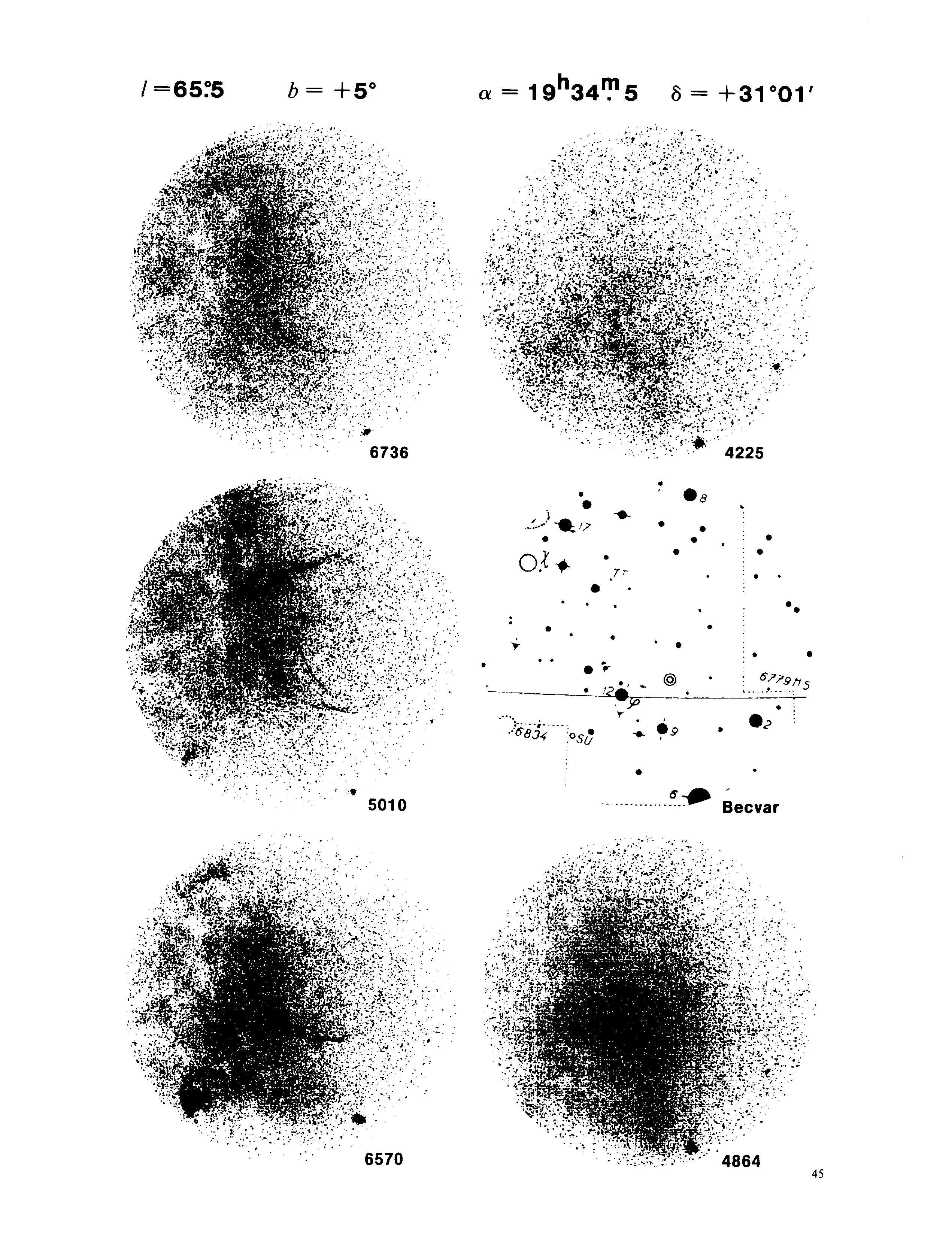
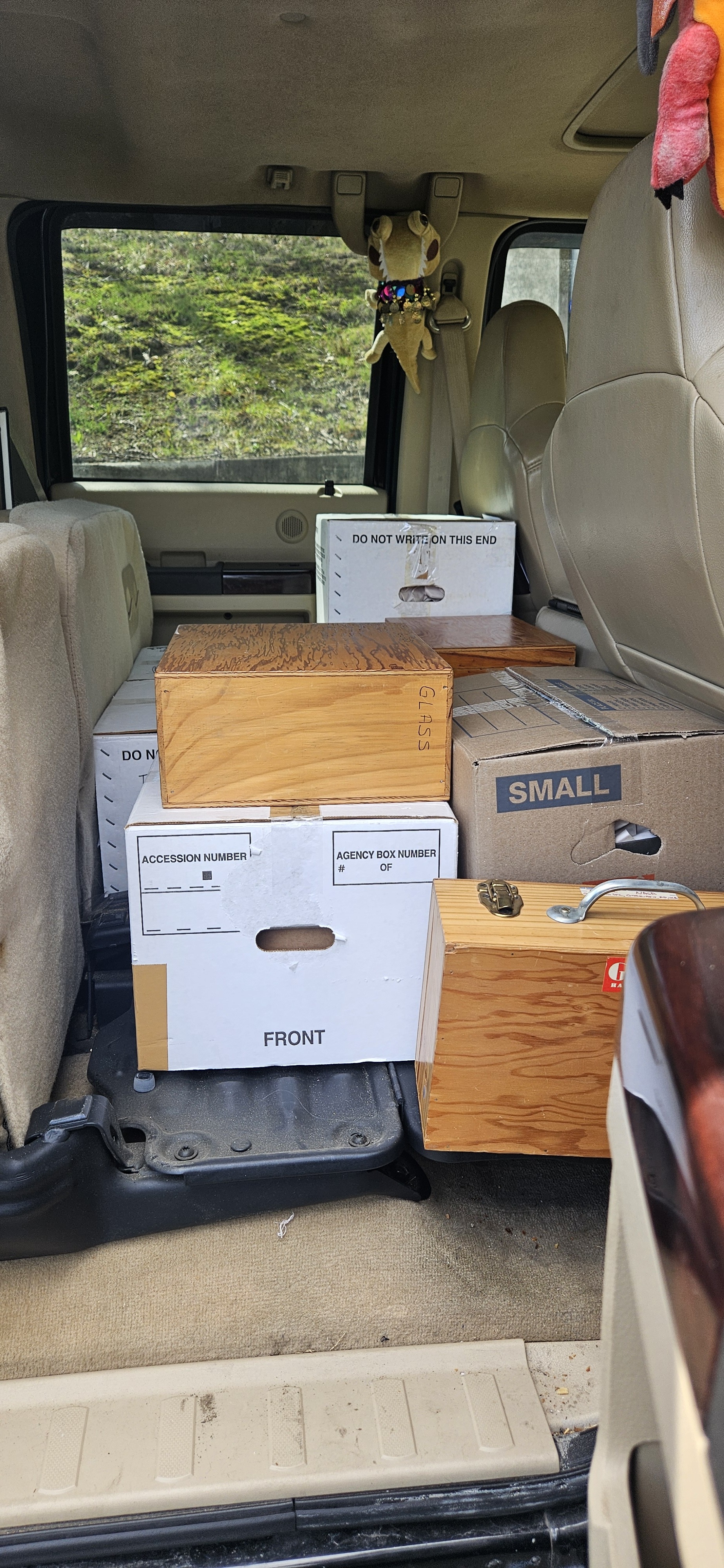
As shown in these scanned pages from the 1979 NASA publication “An emission-line survey of the Milky Way“, not every scan captures all the information present in the originals. At best, these views of our Milky Way are an observation of an observation of an observation. Therefore, when digitizing, retaining the original material if possible is desirable. Here, Ted Gull, one of the original authors, entrusted Jennifer Lynn Bartlett, project scientist for astrophysics, with the original photographic plate negatives. She plans to work with the Harvard Plate Stacks to scan these and make them available in SciX for everyone, However, given their current state and the need to raise funds to support scanning additional historical literature, this project is likely to take several years.

Andrew Harris, chair of the University of Maryland Department of Astronomy, hosted Jennifer Lynn Bartlett, project scientist for astrophysics, last month for a talk about how SciX benefits astronomers and how to adapt the new system to existing workflows. Folks were delighted with the advanced features, such as visualizations, and relieved that they would not have to give up old friends, like the “Classic” form. Jennifer was grateful for their hospitality and appreciated the opportunity to meet with colleagues in person while she was in Maryland.
If your department or project would like a presentation about SciX, please contact jennifer.bartlett@cfa.harvard.edu or adshelp@cfa.harvard.edu.
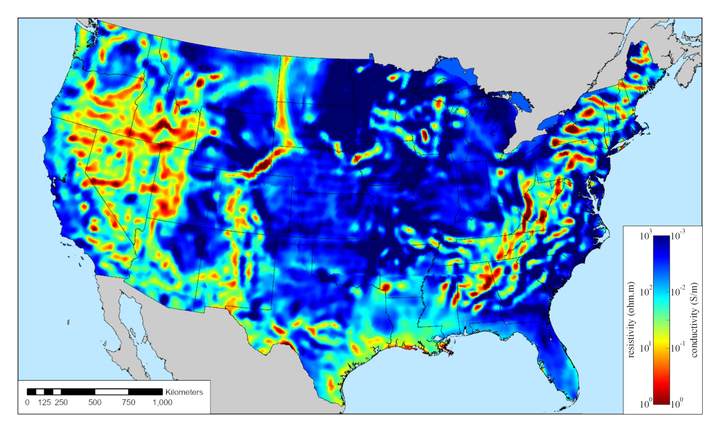
Our own Project Scientist for Earth Science, Dr. Anna Kelbert, is the lead author of a paper that has been making waves this week! The work was recently featured in press releases from the Harvard-Smithsonian Center for Astrophysics, Science, and USGS.
By mapping electrical conductivity of the Earth’s crust and upper mantle across the continental United States, the team discovered that the Appalachian Mountains and the mid-continent sit on ancient continental fragments left over from long-vanished tectonic collisions. This research supports important Earth science applications, including the United States’ capability to mitigate natural geomagnetic hazards that can disrupt the power grids we rely on. The paper reminds us that the ground beneath our feet is anything but simple. What looks like stable, familiar geology is actually a result of complicated dynamics, a stitched-together patchwork of Earth’s deep-time history with direct relevance to our technological present and future. Read the open access paper to learn more!
Website and API Releases
- Added USNO to Bibgroups page
- New blog post about our NASA Astrobiology Collaboration
- Updated the Lead Ambassadors about pages
- 198k new records, and 10.12M new citations.
Development details
April 2026
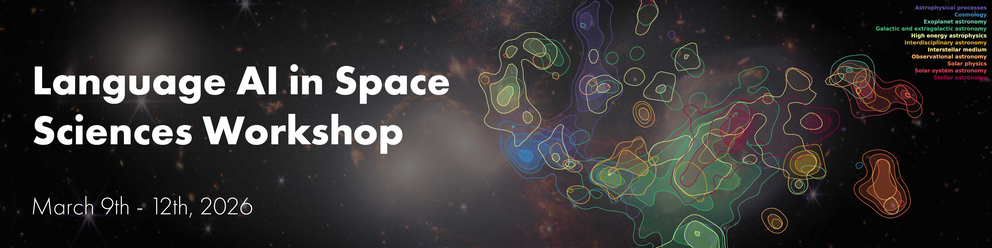
Several ADS and SciX team members participated in the Language AI in Space Sciences Workshop, which was held on March 9-12 in Baltimore, MD. Organized by the Space Telescope Science Institute (STScI), the European Space Agency (ESA), and the Astrophysics Data System (ADS), this unique, interdisciplinary gathering brought together astronomy researchers, AI and natural language processing (NLP) specialists, software engineers, and domain experts. Unlike traditional scientific conferences, the event was heavily focused on hands-on exploration, open discussions, and collaborative projects, allowing participants substantial unstructured time to experiment with emerging tools and methods. The workshop offered a highly interactive environment that fostered creativity and innovation, including tutorials, discussions, and hackathons. Contributions by the ADS team included a discussion on licensing and property rights by Alberto Accomazzi, a tutorial on Retrieval-Augmented Generation by Atilla Alkan, and a presentation on Multilabel Text Classification for Concept Assignment in Astrophysics Literature also by Atilla Alkan. Recordings of the workshop’s presentations are available at on Youtube.
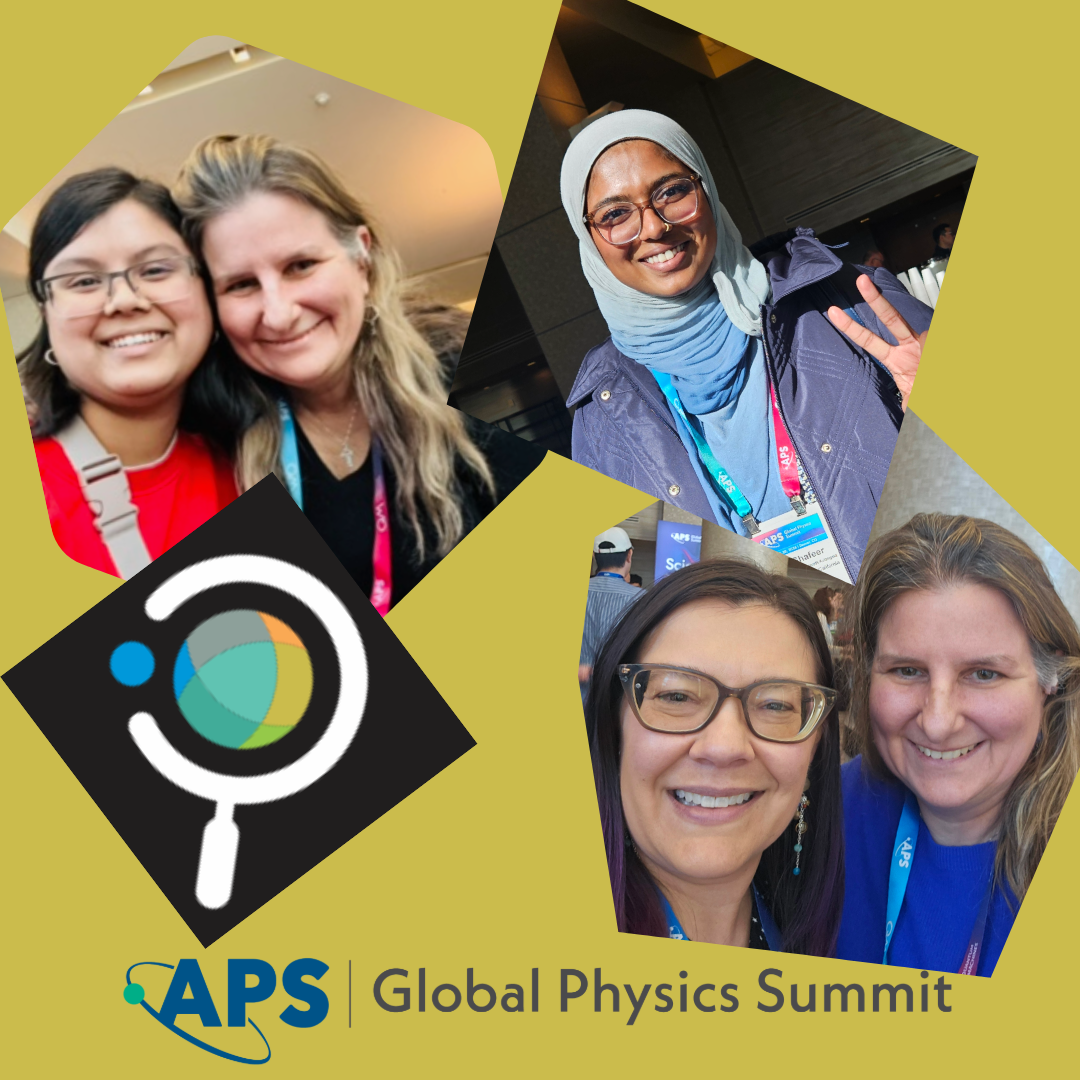
Project Scientist for Astrophysics Jennifer Lynn Bartlett was thrilled to spend a week in the mile-high city talking to physicists with a broad range of interests about how they can find what they are looking for in the SciX. As Glen Bennett, Swastika Acharjee, Naaz Shafeer Vemmerath Kulangara, and Liz Kruesi discovered, the SciX physics collection is extensive, easy to navigate, and free; we welcome new researchers and independent scholars. Read more about it in our blog post and please reach out if you have questions about the ADS to SciX transition or about accessing physics content effectively. Many thanks to the NASA Physics of the Cosmos team, especially Chief Scientist Brian Humensky and public outreach specialist Stephanie Clark, for sharing our Hyatt space with us and to Dan Cooke and all the American Physical Society staff who make sharing our science through the Global Physics Summits possible.
After decades of visionary leadership and unwavering dedication, the Astrophysics Data System (ADS) announces the retirement of our Project Scientist, Dr. Michael J. Kurtz. Michael joined the CfA in 1982 as a research astronomer in the OIR division, participating in both the CfA Redshift Survey and the Century Survey. Michael has been a cornerstone of the ADS since its inception in the early 1990s, helping transform the way researchers access scientific literature. Under his guidance, ADS was conceived and developed into the sophisticated, multi-faceted discovery engine that powers modern astronomical research today.

Beyond his visionary contributions to ADS, Michael is widely respected for his deep understanding of the intersection between information science and astrophysics. His research in bibliometrics and informatics have been widely recognized: in 2000 he received the ISI/ASIST Citation Award for innovation in bibliographic research; in 2001 the AAS awarded him the George Van Biesbroeck Prize for “for the visionary design of the Astrophysics Data System;” in 2018 he was given the best paper award by the Journal of the Association for Information Science and Technology. He is a fellow of the AAS, APS, and AAAS. While we will miss his insight and historical perspective in our daily operations, his legacy is firmly embedded in ADS and its successor, SciX. We invite you to join us in thanking Michael for his extraordinary service and wishing him a rewarding and peaceful retirement.

If you access the historical observatory publications through the “Historical scans currently in the ADS” page or the “Observatory/Society Publications Query Page for the Astronomy database” rather than through the primary ADS or SciX search pages, please contact Project Scientist for Astrophysics and occasional historian of astronomy Jennifer Lynn Bartlett (help@scixplorer.org). We would like your feedback on what these pages provide that our other interfaces do not. As we prepare to complete the transition from ADS to SciX, we plan to modernize these as well, as they have not been maintained for years.
Website and API Releases
- Added Solar Dynamics Observatory to Bibgroups page
- New blog post about our APS 2026 Recap
- 594k new records, and 8.65M new citations.
Development details
March 2026
Spring is in the air in the Northern hemisphere, while our friends in the Southern hemisphere enjoy the transition into cooler autumnal days. However the SciX team have been experiencing four seasons in a day - whether at SciX HQ in Cambridge MA, or on their conference travels in 50 shades of grey Glasgow! The team were out there representing SciX at the recent Ocean Sciences Meeting. Read on to find out what they got up to, and look out for us later this month in Denver CO for the APS Conference.
Wherever you are exploring science, stay safe, and we hope to see you soon!
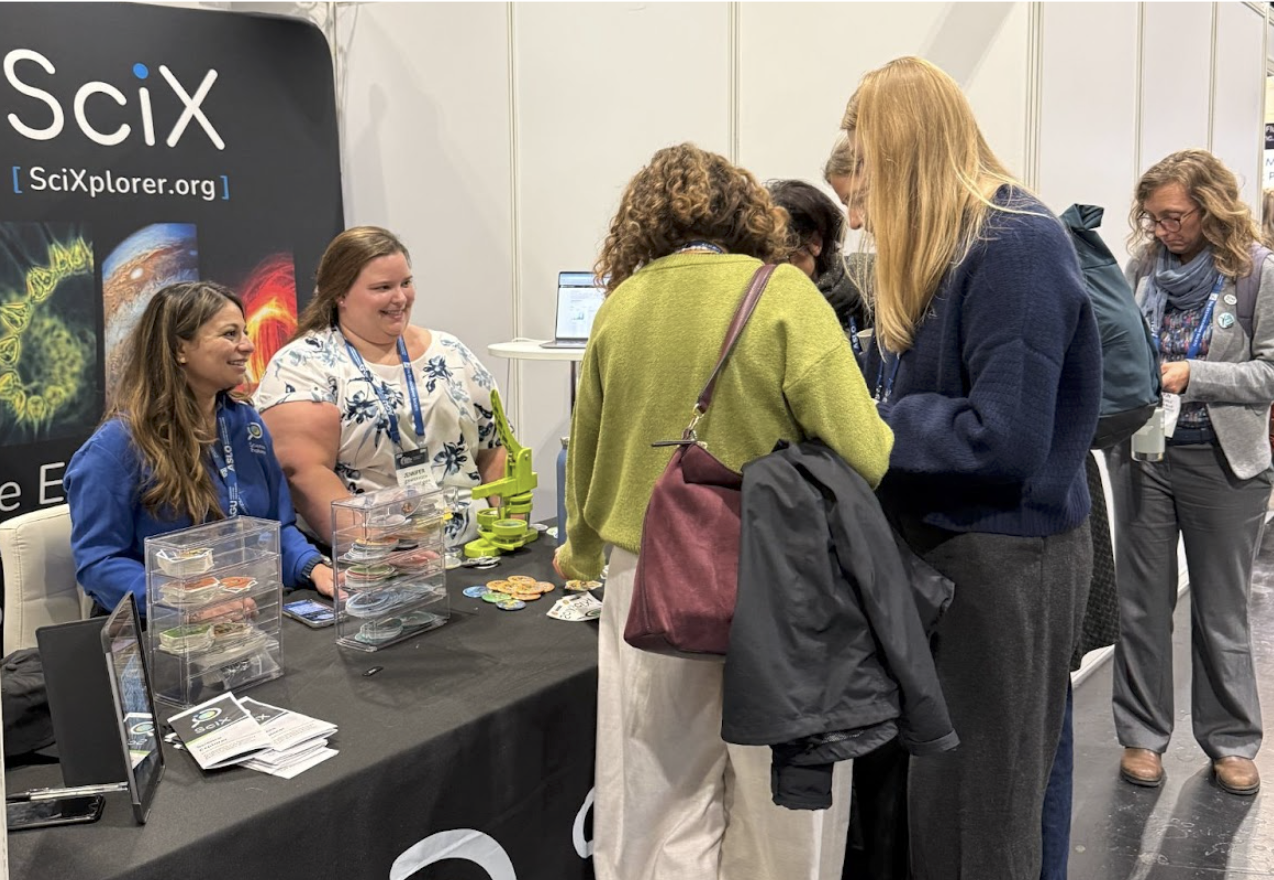
Jenny March and Suze Kundu from the SciX team spent last week in glorious Glasgow, UK where the annual Ocean Sciences Meeting took place. We spent four energising days meeting researchers working across land, sea, and sky. Read our blog post to discover what Claudette Proctor (Stanford) and Kayla Ellerbe (University of Miami) thought of the SciX platform, and find out how interdisciplinary ocean researchers like Bryan Wilson are using NASA’s ECOSTRESS data. While we did run out of our much-loved badges designed by SciX Lead Ambassador Yueyi Che, we made our own interdisciplinary connections with attendees. We even had brushes with royalty \- in the form of a princess, and a boat. OSM 2026 was a joyful reminder that ocean science is global, collaborative, and brilliantly interconnected. Find out more in our OSM write-up!
The SciX team is heading to the 2026 meeting of the American Physical Society (APS) Global Physics Summit, March 15-20 in Denver, Colorado! We’re excited to connect with researchers, learn about the latest discoveries, and share how SciX supports the physics community. If you’ll be attending, be sure to say hello to us at the Hyatt Regency Denver alongside our NASA colleagues.
Website and API Releases
- Added new tutorial videos from Youtube
- Posted the ADSUG 2025 Report
- 4.42M new records, and 6.25M new citations.
- Over 25k publications from the NASA Space Life Sciences Library newly indexed and a bibgroup!
Development details
- Export Service Releases
- v3.1.17 - [fixed] Fixes for AGU, AMS styles
- Journals Database Releases
- v1.3.5 - [improved] Added ‘year’ to completeness schema
- v1.3.4 - [ops] Export (bibcode, canonical abbreviation) to backoffice file
- Nectar Releases
- v0.45.0 - [improved] Show "Record Not Found" in abstract subpages if invalid abstract ID
- v0.42.3 - [new] Add access-level badges (open access vs paid) to full text sources
- v0.41.0 - [improved] Update ORCID work types
- v0.39.0 - [improved] Extract collection and property into query filters
- Solr Service Releases
- v1.1.5 - [fixed] Anonymous BigQuery handler was pointed at solr select endpoint
- v1.1.4 - [improved] Add Non-authenticated user check for handler
- v1.1.3.1 - [fixed] Minor bug that caused highlight queries to fail
- v1.1.3 - [new] Enable keyword & author highlights
- v1.1.2 - [ops] Set UID using new header name
- [fixed] In AASTeX-PSF moved title before journal name
- [improved] Modified sort order based on refereed status
- [improved] Minor change to pipeline command line options: converts input table names to lower case
- [improved] Set password minimum length to 8
- [improved] Improve add to library dialog
- [improved] Render feedback menu items as links for new-tab support
- [improved] Update access labels (open access vs paid)
- [fixed] Prevent facet requests from firing with empty query
- [fixed] Fetching results list bug
- [improved] Filter collections facet to exclude astrophysics, planetary, and heliophysics
- [improved] Redirect correction feedback form
- [improved] Add reset to defaults button on settings pages
- [improved] Make search results items more compact
- [fixed] Search results loading layout bug
- [fixed] Filter empty string orcid values
- [fixed] Prevent truncation of math-heavy abstracts
- [fixed] Typo in visualizations error message
- [improved] Add discipline routes, fix legacy referrer, rename General Science in discipline drop-down menu to “no preferred discipline”
- [improved] Expand authors-per-result preference to 1-50
- [new] Windowed Highlights
- [improved] Remove empty highlights
February 2026
What a start to the year it has been! With the transition from ADS to SciX in full swing, the SciX team has been meeting with members of the SciX Community at meetings and conferences all over. Our goal is for the astronomy community to experience SciX as early as possible and step up to the next generation of literature search and more by the end of 2026. Read on to find out more about where we have been, where you’ll find us next, and some of the most recent developments for Science Explorer, your one-stop shop for research discovery, innovation, and impact, helping you “keep it 100 on the land, the sea, the sky”.
Alberto Accomazzi, Principal Investigator, gave a talk at AAS247 about the benefits of moving to SciX now at the NASA hyperwall. If you weren’t there or you missed our resource links last month, check out our ADS to SciX page and dive in to our Quick Start guide!
Our current SciX transition outreach efforts are focused on showcasing the platform’s power to support astronomical research. Our expanded collections provide access to greater interdisciplinary papers and resources from other disciplines that can make our work easier, in addition to the increasing number of references and citations connected with our system. Astro researchers who tried SciX during recent conferences were pleased by how similar the interface is to ADS, as well as its new features like smooth resizing for a mobile-friendly experience and one-click “copy and paste” citations.
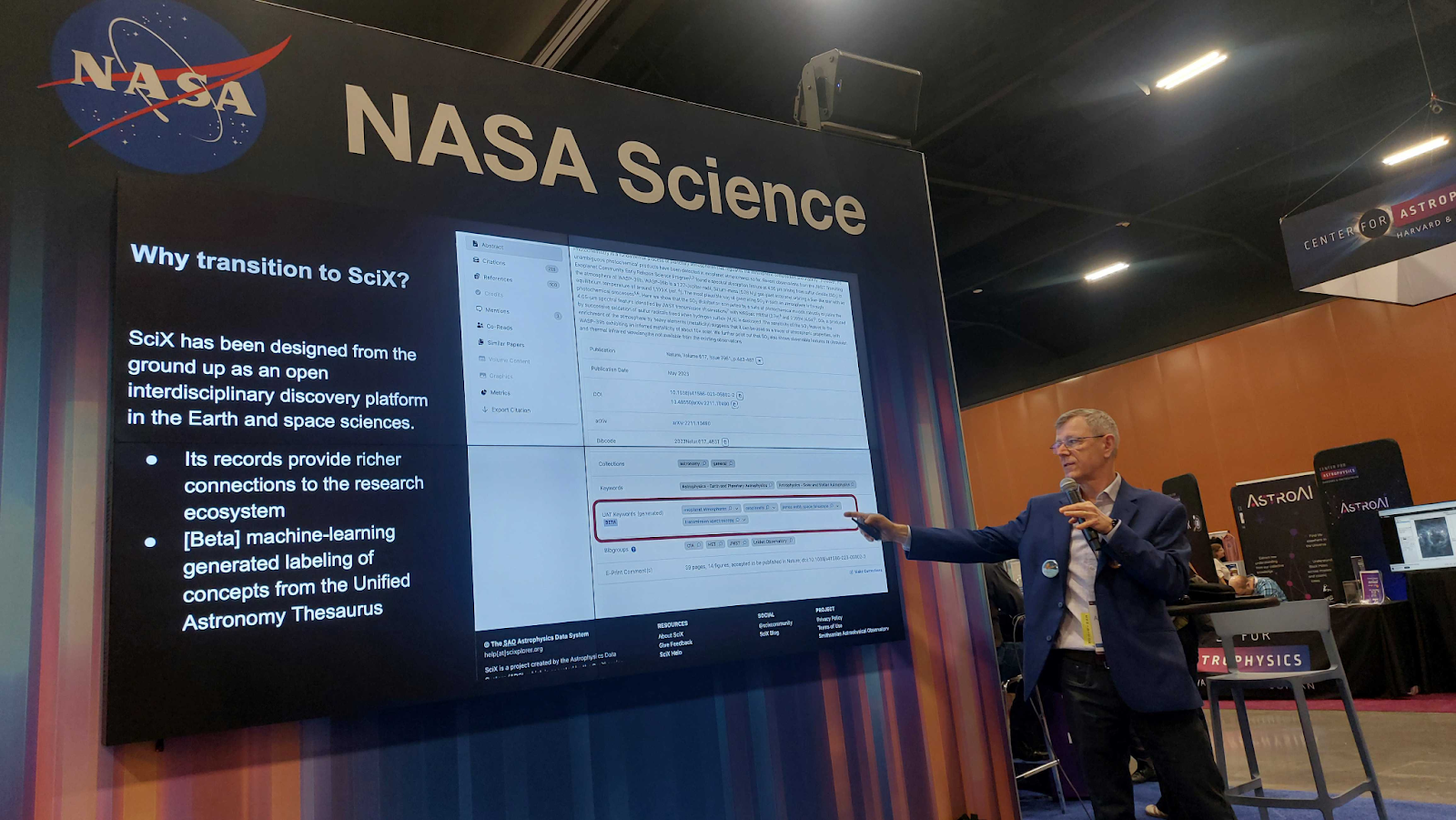
Please help us build an open annotated dataset for multi-label text classification in astrophysics that will further strengthen the discoverability of astronomy research in SciX!. Together, we will create a high-quality training resource to support the development of language models capable of automatically assigning scientific concepts (keywords) to research papers. Such models will enable future information-retrieval tools for astrophysics.
Motivation: Developing robust models for automatic keyword assignment requires carefully annotated training data. Therefore, we will target a representative set of astrophysics research papers and annotate each with the relevant Unified Astronomy Thesaurus (UAT) concepts. Once completed, the dataset will be openly released and will support downstream applications, including automated indexing, topic discovery, and improved literature search capabilities within ADS/SciX.
What Participation Involves: You should be willing to read 5–10 full papers and assign the UAT concepts that best describe their scientific content, following our annotation guidelines. In addition, you will highlight the text fragments that justify each selected keyword. The selections will help with explainability and model interpretability. Finally, you may be asked to participate in a virtual discussion to finalize keyword selection when annotators disagree on their selections.
How to Participate: Please indicate your interest using this short form. We will follow up to provide the annotation guidelines, example annotations, and access to the annotation interface. Please contact Atilla Alkan with any questions. We hope you will collaborate with us to build a shared, reusable dataset to benefit the entire astrophysics community.
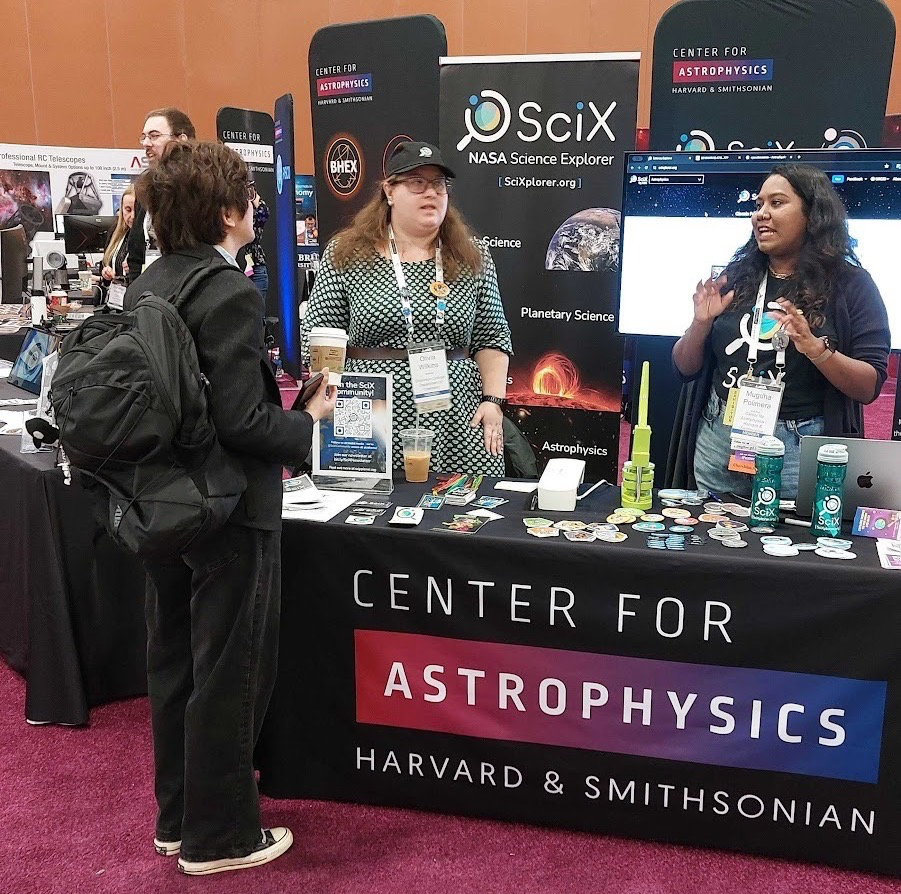
SciX team members, Alberto Accomazzi, Atilla Alkan, Carolyn Grant, Edwin Henneken, Jennifer Lynn Bartlett, and Mugdha Polimera, enjoyed meeting so many new users and old friends at the 247th meeting of the American Astronomical Society held in Phoenix, AZ during the first full week of January.
Olivia “Harper” Wilkins, Dickinson College chemistry professor and SciX Lead Ambassador, co-led our workshops on Sunday afternoon. Everyone contributed to staffing the booth, which featured stickers with artwork of Yueyi Che, PhD student at UC Irvine and SciX Lead Ambassador.
Mugdha, back-end developer, presented “The Future of Scientific Discovery: Responsible AI/ML Enhancements in ADS and SciX” describing how we enrich our collections and enable you to search for papers, datasets, and software in more nuanced ways.
Atilla, AI/ML postdoctoral researcher, presented “Concept Classification Across Scientific Domains: Adapting to the Unified Astronomy Thesaurus’s Expansion into Heliophysics” describing our approach to automated classification of scientific records to accelerate discovery and improve search.
Jennifer, project scientist for astrophysics, presented “Science Explorer: Open Science Discovery Engine” describing a Library Carpentry course for new SciX users. She also presented “Science Explorer and StarGlass: the Future of the Historical Sky” demonstrating the linking of astronomical photographic plates (observations) to articles and logbooks. In addition, she organized splinter sessions for the Working Group on the Preservation of Astronomical Heritage and the Working Group on the Unified Astronomy Thesaurus (UAT). SciX continues the ADS tradition of making the historical literature of astronomy accessible to scientists, historians, and educators. The UAT is our preferred vocabulary for astronomy concepts and keywords; improving its content and its use will improve searches for astronomy topics and help make connections among similar ideas in other disciplines.
Team members Kelly Lockhart, Daniel Chivvis, and Anna Kelbert joined thousands of others in braving the thing they love most - BIG WEATHER - to attend the American Meteorological Society conference in Houston, Texas, at the end of January. Anna, the Project Scientist for Earth Science at SciX, gave a talk titled “Discovering Space Weather Resources in Science Explorer using Keyword Enrichments” at a session focused on the current state and future of space weather research.
We loved meeting you all and hearing about the unique challenges that you are helping overcome. The AMS meeting is a real opportunity to see how interdisciplinary research leads to impactful realities. From atmospheric aerosols to Zonda winds, SciX has your research A-Z covered.
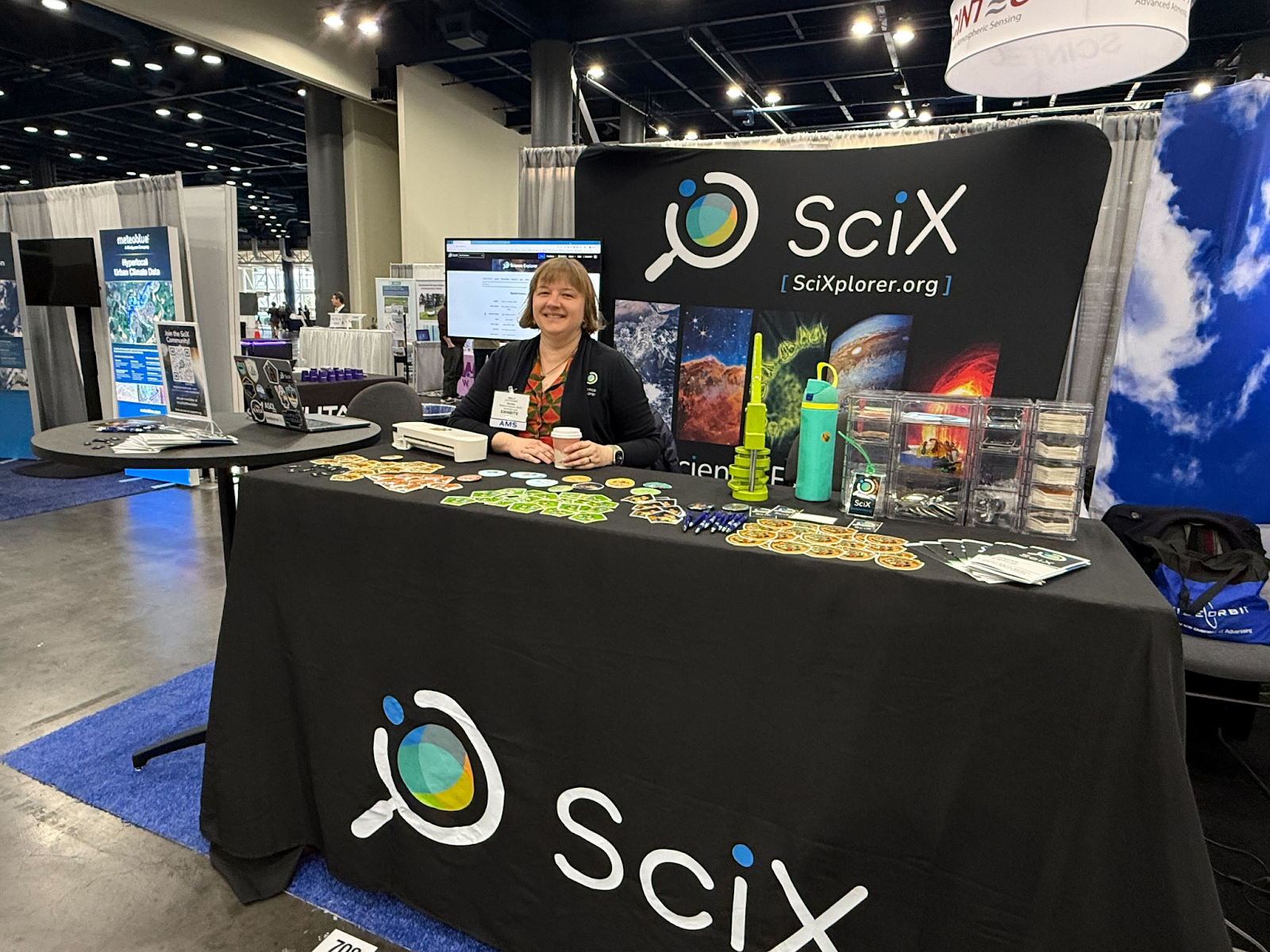
If you missed us at AGU, AAS, AMS, or any other conference with a three-letter acronym, don’t fear because we’ll soon be at more conferences with three-letter acronyms! We just can’t get enough of interacting with our community. We’ll be attending the Ocean Sciences Meeting in Glasgow, UK at the end of February. The team will be on hand to answer any questions you might have about how you can use this free and open platform to explore the kind of interdisciplinary research that lurks in the depths of the sea. We’ll also be bringing some of our cute swag, and if you can successfully use the clues to Guess the Science Explorer, you’ll also be in with a chance of winning some very exclusive SciX merchandise! Swing by Booth Number 85. We look forward to seeing you there - as they say in Scottish Gaelic, tha mi air bhioran!
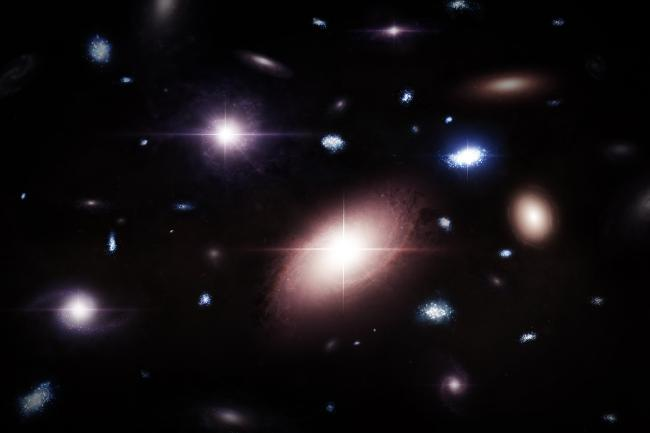
Mugdha Polimera, SciX back-end developer and astrophysicist, shone in her dual roles at AAS247 with her presentation on “From Dwarfs to Giants: A Complete Census of AGN Across the RESOLVE and ECO Surveys.” She and her co-authors show the demographics of active galactic nuclei (AGN), i.e., actively accreting supermassive black holes, and their hosts shift dramatically with galaxy mass.
The results show that AGN are more common in dwarf galaxies than most previous surveys suggested, but also reveal a sharp increase in AGN frequency in transitional galaxies around the same mass as the Milky Way. They argue the transition reflects how the cold gas accretion in the host galaxies and the dark matter mass of the group haloes could regulate black hole growth and star formation.
Check out the January 8 press conference and press release featuring her work!
Data holdings and pipelines
- 128k new records, and 2.48M new citations.
- Over 4300 NASA Earth Science proposals newly indexed
Development details
- Bumblebee Releases
- v1.10.13 - [new] Added setting to view ALL authors per search result
- v1.10.12 - [ops] Recaptcha authorization
- v1.10.11
- v1.10.10 - [ops] Recaptcha loading and error tracking
- v1.10.9 - [ops] Redirect url pattern
- v1.10.8 - [new] Menu and button for ADS to Scix transition
- Nectar Releases
- v0.37.7 - [new] Added the ability to adjust items per page on abstract subpages
- v0.34.14 - [new] Added tooltips in search results page
- Solr Releases
- [improved] Strip HTML tags from document title on abstract pages
- [improved] Added UAT to all search terms dropdown
- [new] Implement 'authors per result' user preference
- [improved] Updated quick citation format list to display most popular formats
- [improved] Adjusted font colors, font sizes, icons sizes to improve readability
- [improved] Redirect users to original page after login
- [improved] Made landing page form selection sticky
- [improved] Strip HTML tags from title in browser tab and meta tags
- [fixed] Use OR operator for multiple collections in classic form
- [fixed] Icon not shown on Safari
- [fixed] Show 'back to results' link when query is *:*
- [fixed] New line not shown in html citation
- [fixed] Show ORCiD session expired warning only once
- [ops] Error handling, performance, and robustness
- [ops] Dependency updates
- [ops] Sanitized middleware logging and added tracing headers
- [new] Added 'By ADS' to logos when in astrophysics, heliophysics, or planetary modes
- [improved] Add back buttons for tours
- [improved] Enhanced metadata tags for full ADS parity
- [improved] Improved the visibility of the Highlights button and now label each highlight with its source field for clearer context
- [fixed] Removed n param from url
- [fixed] Library copy citation bug
- [fixed] Prevent ADS mode reactivation on page load/navigation
- [ops] Dependency updates
- [ops] Improved middleware test coverage
January 2026
Happy New Year!
We are thrilled to bring you the first SciX Newsletter of the year. In last month’s newsletter, we reflected on a year of evolution. As we embark on a brand new year, and with our future secured thanks to some recent funding-related good news, our focus and commitment to ensuring a seamless transition from ADS to SciX and a smooth onboarding for new SciX users remain our main priorities.
With that in mind, as always, if you have any questions, please don’t hesitate to contact us by email at help@scixplorer.org, or by using this feedback form. Thanks for being a valuable and valued member of our community.
We had a great time meeting SciX-curious attendees at #AGU25 last month! From existing ADS users that have already made the switch, to people brand new to our platform, we were excited by the research community’s excitement for the platform. We are always keen to showcase our user stories, so if you’ve been using SciX to help accelerate your research discovery, innovation and impact and want to tell your story via a short video or a post on our blog, get in touch.
Whether you saw one of our or our Ambassador’s panel discussions, posters, NASA hyperwall talks, or whether you managed to grab one of our hundreds of SciX badges before they ran out on the last day, thanks for engaging with us. If you missed us, look out for us at #AAS247. We’ll also be attending AMS and OSM in the next couple of months. If you’d like to arrange a chat with one of our team to find out more about SciX, please let us know.

Website and API Releases Data holdings and pipelines
- 168k new records, and 3.86M new citations.
Development details
- API Gateway Releases
- v1.2.4 - [improved] Added nectar feedback form
- Nectar Releases
- v0.29.2 - [new] Added 'keyword' and 'author' fields to highlights
- Solr Service Releases
- v1.1.1 - [improved] Enabled boost type mapping
- [improved] Empty abstract graphics state
- [improved] Auto-set ASTROPHYSICS mode for legacy ADS users
- [fixed] Prevented undefined error in AbstractSideNav
- [fixed] Authors field edit bug
- [fixed] Restored notifications on login page and added ADS credentials message
- [fixed] Abstract page title to show paper title on direct navigation
- [ops] Enabled injecting query parameters