 Science Explorer
What's New
December 2025
We can’t believe it’s already December. As we look back on another year of supporting research, we want to take a moment to thank you, our loyal user community. ADS and SciX are made by scientists, for scientists, and we couldn’t do any of this without your feedback. With all that being said, this month’s newsletter contains some news about the future of our platforms. We want to assure all of our users that we are committed to working through these impending changes with you. As such, if you have any questions, please don’t hesitate to contact us by email at help@scixplorer.org, or by using this feedback form. Thanks for being a continued part of our community. Read on to find out more.
- ADS is Evolving in 2026
2026 will be a transition year for ADS users, as the astronomy community moves to the astrophysics version of SciX. Our development team is working to ensure that astronomers have as smooth a transition as possible. In all of this, we remain committed to serving the astronomy community.
- In the meantime, ADS users will be glad to know that: + You can use your existing ADS account with SciX; sign in with the same credentials + Your libraries, settings, and notifications will continue as is + Your links will be automatically redirected; you will not need to change any of them + You can still use the Classic interface in SciX + Choosing the astrophysics discipline prioritizes astronomy results in your searches, or you can restrict your searches to our astronomy and physics collections for a more focused ADS-like experience.
- When you switch to SciX, you get the benefits of:
- Astrophysics-focused literature, data, and software searches within a larger multidisciplinary collection
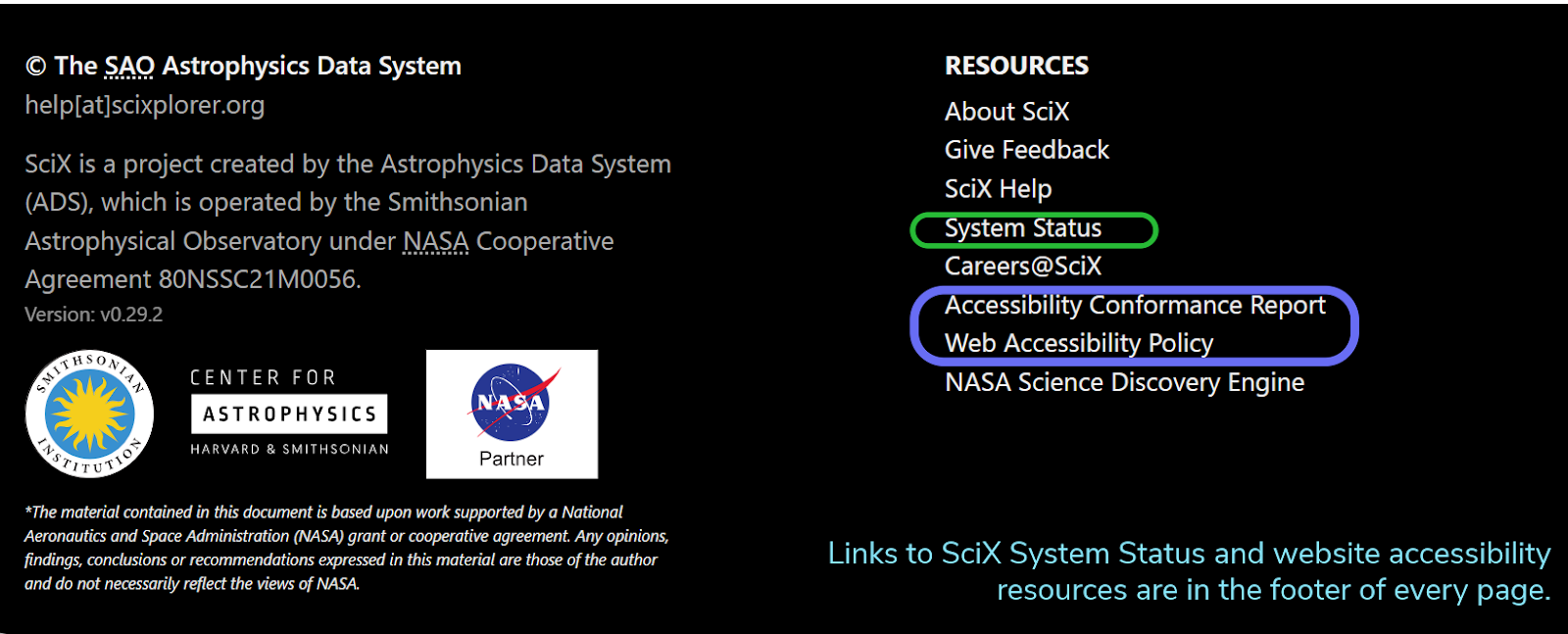
- Improved speed and reliability, including a dashboard to check system status if you need it
- Better accessibility compliance so that all scientists can access our resources
- Mobile-friendly interface that adapts to smaller screens for working wherever you are
- Copy-and-paste citations
- NASA and NSF proposals, awards, and associated papers
- Links among papers, proposals, data, and software through less formal mentions and credits in addition to traditional citations
- Searchable filters for narrowing your search
- Type-ahead support to help you formulate queries
- Tags on abstract pages that identify refereed status, collection, document type, and bibliographic group
- [beta] concepts assigned from the Unified Astronomy Thesaurus (UAT) providing a consistent set of keywords across astronomy papers, datasets, and software
Keep an eye out for links to more information, including onboarding tutorials, and lived-experience testimonials from existing ADS users that have transitioned into regular SciX users. If there are any other resources that you feel would benefit the astro community in this transition, please share your thoughts with us, either by email at help@scixplorer.org, or via this feedback form.
This exciting step into a new era of ADS’s long established history will help you expand the reach of your research, and unlock a huge amount of previously untapped collaborative potential, making your research even more impactful than it has been before. We are looking forward to going on this journey with you, and we are so excited to see how the expanded SciX coverage supports your work. If you just can’t wait, head on over to our Quick Start Guide and start exploring for yourself!
- Astrophysics-focused literature, data, and software searches within a larger multidisciplinary collection
- In the meantime, ADS users will be glad to know that: + You can use your existing ADS account with SciX; sign in with the same credentials + Your libraries, settings, and notifications will continue as is + Your links will be automatically redirected; you will not need to change any of them + You can still use the Classic interface in SciX + Choosing the astrophysics discipline prioritizes astronomy results in your searches, or you can restrict your searches to our astronomy and physics collections for a more focused ADS-like experience.
-
SciX Workshop at AAS 247
 Jump into SciX and accelerate your research with our “Exploring SciX: A Researcher’s Guide to the Science Explorer Platform” Workshop on Sunday, January 4 at the American Astronomical Society Meeting. Three complimentary (FREE!) 1-hour sessions will be offered at 1 PM, 2 PM, and 3 PM in Phoenix Convention Center, Room 126 A. Whether you are an old ADS hand who is ready to transition to a multidisciplinary environment or a new researcher who needs to navigate your first literature search effectively and efficiently, you will find the resources and support you need in one of these sessions.
We have been working with AAS staff to reconfigure this workshop to make it available to as many people as possible. You should be able to register for the shorter, free sessions through the AAS registration site shortly. If you have already registered for the meeting, you can just add this event to your registration.
If you will be at AAS but you can’t make the workshop, please stop by our booth for a demonstration. You will like what you see.
-
2025 ADS Users Group Meeting
The ADS Users Group met on November 20 and 21 to review how well ADS and SciX are performing, to assess progress towards our vision of a single multidisciplinary digital library, and to prioritize goals for the coming year. With continuing budget uncertainty, we provided plans based on two scenarios: full funding for both ADS and SciX and funding for ADS only. While SciX met expectations and launched as a fully functional interface to our extensive collections in September, the 2025 ADS User Survey showed that the astronomical community remains uncertain about embracing a new access point, only six years after the last major revision. While we wait for the ADS Users Group report, you can see our presentations online.

-
See You At AGU25!
Some members of the SciX team will be at the AGU25 Conference in New Orleans later this month. Swing by booth #1532 to learn more about the platform and discover how it can catalyse your research, discovery and impact in the Earth, ocean and planetary sciences!We will also be giving talks, demos and presenting posters at the conference so we hope our paths cross with as many current and future users as possible!
Development and data holdings updates as of December 1st:
- Website and API
- [new] Updated ADSUG charter; added ADSUG 2025 meeting
- [improved] Updated links on help pages
- Data holdings and pipelines
- 582k new records, and 10.72M new citations
Development details
- Bumblebee Releases
- v1.10.7 - [fixed] Loading for empty affiliations being displayed
- Nectar Releases
- v0.26.0 - [new] Added journal autocomplete and enhanced UAT search
- v0.25.1 - [new] Added readable publication date formatting
- Resolver Gateway Releases
- v2.1.3 - [fixed] Remove forced redirect for links not in the valid referrers list
- v2.1.2 - [improved] Updated SciX logo url for landing page
- Resolver Service Releases
- v2.0.27 - [improved] Converted link subtype to be case insensitive
- Solr Releases
- v96.2.0 - [improved] Enabled other identifiers in bitset query parser
- [ops] Feedback integration update
- [improved] Updated help link to /scixhelp/
- [improved] Fetching of associated materials
- [improved] Display of abstract page metadata
- [fixed] Added validation of `pageSize` to fix pagination errors
- [ops] handle forbidden user settings fetch gracefully
- [ops] Updated SciX ID prefix to special case queries
November 2025
- Announcements:
- SciX visits San Antonio for GSA Connects 2025
San Antonio served up sunshine, science, and a whole lot of curiosity at this year’s GSA Connects 2025, held at the Henry B. González Convention Center. Against the backdrop of the city’s iconic River Walk and limestone heritage, the SciX team joined thousands of geoscientists, data specialists, and Earth explorers for a week of discovery and dialogue.
Our mission? To show how open and FAIR research platforms can help bridge disciplines and catalyse collaboration - because the biggest challenges on (and beyond) our planet can’t be solved with research that lives in a single science silo.
Through our booth and Dr Anna Kelbert’s demo-talk on the Innovation Stage, we had the pleasure of meeting SciX users old and new - and we’d love to see more of you at the AGU conference in New Orleans next month!

-
ADS Survey
 If you have not already let us know what you think about how ADS is performing, please complete our survey soon. We value your feedback. However, we are currently making upgrades only to the SciX interface because we will eventually have to consolidate all our users on a single platform. Therefore, we are especially interested in knowing whether you have tried SciX.
 -
ADS Users Group Meeting: Nov. 20-21
The ADS Users Group will meet virtually on November 20 and 21 to review the state of ADS and operational plans for next year. Community guidance is especially important as we strive to support researchers in this challenging and uncertain environment. Please let either the chair or the PI know of any issues they should consider or contact the PI for an invitation to the public sessions. We will be updating the ADS Users Group webpage as the meeting approaches with the newest members and planned presentations. - LISA 10
 Edwin Henneken, Content, Curation & Collaborations Lead, and Jennifer Lynn Bartlett, Project Scientist for Astrophysics, presented virtually at the Library and Information Services in Astronomy meeting at the beginning of this month. Edwin presented on how the ADS/SciX links to and indexes data products. Jennifer discussed recent work to apply keywords from the Unified Astronomy Thesaurus (UAT) automatically to astronomy papers, datasets, and software to make them more easily findable. SciX Ambassador Manuel Pichardo Marcano translated the presentation into Spanish.
- SciX visits San Antonio for GSA Connects 2025
- Development and data holdings updates as of November 1st:
- Website and API
- [improved] Updated Bibcodes help page
- [improved] Updated Data FAQ page
- [improved] Updated positional field search information for last author searches
- [improved] Speed improvements
- Data holdings and pipelines
- 561K new records, and 5.72M new citations
- Website and API
Development details
- Bumblebee Releases
- v1.10.6 - [fixed] DOI disappearing during after loading an abstract
- v1.10.5 - [fixed] Author load issue on abstract pages
- v1.10.4 - [fixed] Year/citation graph loading issues
- v1.10.3
- v1.10.2 - [improved] Added banner for partial results
- Nectar Releases
- v0.22.42 - [improved] Facet updates and fixes
- v0.22.35 - [new] Added last author search to All Search Terms menu
- v0.22.29 - [improved] Smartened the paper form bibcode query
- Resolver Gateway Releases
- v2.1.1 - [fixed] Error when no link type is specified
- v2.1.0 - [improved] Updated redirecting of links from classic articles service to scan-explorer
- Solr Releases
- v96.1.6 - [improved] Added fields to the data schema to be used with boost functions, supporting discipline specific rankings
- [improved] Use default query for empty classic form
- [improved] Optimized fetching of the search results to reduce payload size
- [ops] Added tags to search page queries for analytics
- [ops] Added null check when deleting all records from a library
- [improved] Show total credit count in search results when sorted by search count
- [fixed] Guard conditions for handling citation helper suggestions
- [fixed] Removed “-00” from pubdates without days
- [ops] Added ADS login note
- [improved] Updated “pub” search in quickfield dropdown and examples
- [fixed] Carousel bug
- [ops] Added JSON-LD metadata generator for abstract pages
- [ops] Properly reset the user state after login
- [ops] Added UI variant for ADS or SciX
October 2025
- Announcements:
- SciX Has Officially Launched!
We are delighted to share that the non-beta version of SciX officially launched on September 29th! This milestone represents the culmination of our community’s collective effort to build a platform that expands on ADS and provides integrated access to research across Earth, environmental and space sciences, including planetary science, heliophysics, geology, geophysics, atmospheric sciences and oceanography. Check out our new video here!
You can access the platform at scixplorer.org.
You can also read our launch blog post, read the NASA Science Data Portal’s news item, and read the Center for Astrophysics Harvard & Smithsonian’s press release too!
As part of the launch, we’ll be sharing updates and news across social media, and it would be wonderful if you could support us in three simple ways:
1. Keep an eye out for SciX launch posts on our social media channels and amplify them through your own networks - we are @SciXCommunity everywhere! LinkedIn 🔎 X 🔎 Bluesky 🔎 Facebook 🔎 Instagram 🔎 Mastodon
2. Provide us with a short testimonial about SciX - why it matters to you, to your field, or to the broader research ecosystem3. Invite at least two colleagues (ideally from diverse areas of research) to also share a testimonial. Personal recommendations go a long way in highlighting the value and impact of SciX - please let us know if we can help with this.
Thanks for embarking on this journey with us - we are so happy to have you on board!
- Professional Development Training - Register Your Interest!
Are you a current ADS user curious to learn more about how you can further elevate your research with the extra functionality offered by Science Explorer (SciX), or are you a current SciX user that wants to learn more about how you can utilize all the fantastic features on this new platform to support your work? Then register your interest in our professional development training program using this form! Once we have an indication of the best formats for this training to take place, we will be in touch with more information. Engaging with our users helps us build a platform that best suits the needs of the research community, and every bit of feedback helps us as well as the broader research landscape, so please share the link with your colleagues and collaborators.
- SciX Has Officially Launched!
- Development and data holdings updates as of October 1st:
- Website and API
- [new] SciX Homepage
- [new] New Quick Start help page
- [new] Blog post celebrating SciX Launch
- Bumblebee releases:
- [new] Added PubMed full source links
- [improved] Added link to system status page in footer
- [fixed] Updated submodule for feedback form bug
- Export Service releases:
- [improved] Added support for BibTeX
techreportdocument type - [fixed] ASCL BibTeX format
- [improved] Added support for BibTeX
- Nectar releases:
- [improved] Landing page updates
- [improved] Tooltips for abstract page
- [improved] Improve search error message
- [improved] Allow facet download at different levels
- [fixed] Author affiliation form load error with some queries
- [fixed] Notifications on protected pages
- [fixed] Facets are now correctly applied in 2nd order operations
- [ops] Updated SciX email contact for Feedback and Help pages
- Data holdings and pipelines
- 510K new records, and 8.44M new citations
- This month we have added several noteworthy data holdings, included but not limited to:
- 1.25 million journal articles from IEEE
- 63K conference abstracts from the Goldschmidt conference series
- 33K technical reports from NASA’s NTRS
- 16K datasets from USGS
- 6K software records from USGS and DOE
- Website and API
Development details
September 2025
- Announcements:
-
SciX is Out of Beta and Ready for Take-Off!
Help us gear up for launch! Science Explorer’s Beta label has officially been removed, and momentum is building as we prepare for our full launch of the platform on 30th September. This is an exciting milestone for the community, and we’d love your help in spreading the word. Keep an eye out for SciX launch content across our social media channels, and please share it with your networks, colleagues, and collaborators. Together, we can make sure that more researchers discover the power of SciX.If you’re already a SciX user and would like to be part of our launch, we are collecting stories from our users about how the tool has revolutionized their research. If you would like to share your own story, either by text or in a short video, follow this link to complete the form.
- Professional Development Training - Register Your Interest!
Are you a current ADS user curious to learn more about how you can further elevate your research with the extra functionality offered by Science Explorer (SciX), or are you a current SciX user that wants to learn more about how you can utilize all the fantastic features on this new platform to support your work? Then register your interest in our professional development training program using this form! Once we have an indication of the best formats for this training to take place, we will be in touch with more information. Engaging with our users helps us build a platform that best suits the needs of the research community, and every bit of feedback helps us as well as the broader research landscape, so please share the link with your colleagues and collaborators. - “SciX Data Collections” Blog Post
We have published a new blog post about data collections in ADS/SciX! Tracking the use of research data and software in the scientific literature is one of the primary goals of SciX, and maintaining data collections is the primary way for users to discover them. This blog post describes how SciX curators generate and maintain these resources and how users benefit from having them integrated into the system. Please see the blog post for more details. -
SciX at the NASA Open Source Science Data Repositories Workshop
The Science Explorer was featured at the NASA Open Source Science Data Repositories Workshop, which was held in Huntsville, AL, August 25-27. The workshop brings together NASA data officers, repository data stewards, NASA-funded data producers, and NASA Office of the Chief Science Data Officer (OCSDO) leadership to discuss current issues collaboratively and identify potential scientific data and information solutions that can be developed and implemented across NASA Science Mission Directorate (SMD) repositories. Alberto Accomazzi, the SciX PI, gave two presentations: “What’s new with SciX” and “Metrics that Count with SciX,” in addition to a demo of the system. -
NASA Awards Indexed
We have added records for NASA Awards in astrophysics and heliophysics projects in an ongoing effort to index NASA science proposals and awards. In addition, we are enriching the records with respective award information from USASpending.gov, which supports searching by grant numbers. -
SciX at Sea
In July, Jennifer Lynn Bartlett, project scientist for astrophysics, sailed from Victoria, British Columbia, to San Francisco, California, on the Coast Guard Academy training ship, a three-masted barque, to assist with celestial navigation instruction. Despite global GPS coverage, sailors still need to know how to operate without it. With the cadets, she enjoyed drawing the connections that join sky and ocean. If you are more a sea enthusiast, then you should also appreciate SciX’s coverage of oceanography, including more than 15,000 open-access, refereed articles. For more than 500 oceanographic publications, we have linked them directly to their associated datasets. From Polaris to the Pacific, SciX is your guide to the scientific literature. - Welcome to Our New Team Members
We are pleased to welcome new members to our team! Dr. Atilla Kaan Alkan joins us as a postdoctoral research fellow specializing in NLP for astrophysics. Dr. Suze Kundu joins us as Research Community Engagement Consultant in support of SciX initiatives. Learn more about them on our Team page!
-
- Development and data holdings updates as of September 1st:
- Website and API
- [new] SciX Data Collections blog post
- [new] Team page: Added Dr. Atilla Kaan Alkan and Dr. Suze Kundu
- Export Service releases:
- [improved] Added support of new doctypes (
instrumentandservice) - [improved] Edited manifest endpoint to update file extensions
- [improved] Added handling for MathML markup
- [improved] Added support of new doctypes (
- Nectar releases:
- [new] Added “Credits” and “Mentions” to left menu bar on abstracts’ pages, which display the software and datasets mentioned by a given paper or any papers that credit a given software package or dataset
- [improved] Added
boostTypeparameter to search based on the App Mode - [improved] Added warning message on potentially incomplete search results
- [fixed] Fixed issue with email input
- [fixed] Fixed an autocomplete menu behavior ensuring the menu closes when the first suggested item matches exactly the search input
- [fixed] Text overlap issue
- [fixed] Issue with alpha sorting in facets modal
- [fixed] Library pagination bug
- [ops] Updated logo
- Solr releases:
- [new] Added software mentions schema fields:
mention,mention_count,credit,credit_count - [improved] Updated the schema to include
reference_count
- [new] Added software mentions schema fields:
- Vault releases:
- [new] Added logic to convert myADS emails to SciX email notifications if notifications are created or edited in SciX
- [improved] Allow auto-updating of user library link servers
- [ops] Allow users to remove arxiv papers coming from
get other papersfor email notification - [ops] Allow for separate banners on ADS and SciX
- Data holdings and pipelines
- 289K new records, and 2.99M new citations
- Website and API
Development details
August 2025
- Announcements:
- Professional Development Training - Register Your Interest!
Are you a current ADS user curious to learn more about how you can further elevate your research with the extra functionality offered by Science Explorer (SciX), or are you a current SciX user that wants to learn more about how you can utilize all the fantastic features on this new platform to support your work? Then register your interest in our professional development training program using this form! Once we have an indication of the best formats for this training to take place, we will be in touch with more information. Engaging with our users helps us build a platform that best suits the needs of the research community, and every bit of feedback helps us as well as the broader research landscape, so please share the link with your colleagues and collaborators. - Getting Resources Ready for a New Year
SciX has over 175,000 physics and astronomy education research articles; most are available in the PhysEd bibgroup. By submitting feedback, you can help us link the written descriptions to the associated supplementary materials that make these resources most useful:- Go to the “Feedback” dropdown menu at the upper right of the SciX web interface, and select the “Associated Articles” option.
- On the “Submit Associated Articles for the SciX Abstract Service” form, choose “Other” from the “Relation Type” dropdown menu.
- Describe the resource relationship briefly in the “Custom Relation Type” text box.
- Then, input the bibcode of the article and a link to the resource.
If we are missing something you use, let us know by selecting the “Missing/Incorrect Record” option on the “Feedback” dropdown. Sharing supplemental materials through SciX ensures these resources remain findable and accessible and continue to be reused.
- Astrometry: the “Old Astronomy”
In the late 19th century, a debate raged over whether astronomy was properly the study of the positions and motions of celestial bodies (astrometry) or could include techniques from the physics and chemistry laboratories (astrophysics). Project Scientist for Astrophysics Jennifer Lynn Bartlett is an astrometrist by training. She is going way back to basics and teaching naked-eye astronomy and constellation identification for the first half of this month. Lucky for us, she plans to rejoin the 21st century for the fall.
- Professional Development Training - Register Your Interest!
- Development and data holdings updates as of August 1st:
- Website and API
- Nectar releases:
- [new] Support of PubMed Central links in Full Text Sources
- [improved] Show download button to all facet modals
- [improved] Added system status page link in footer
- [improved] Added banner for system wide message
- [fixed] Improved search input, fixed bug that caused input to clear unexpectedly
- [fixed] Deduplicate incoming esource URLs
- [ops] Added key alias entry in search filter tuple (quadruple)
- Journals Database releases:
- [improved] Added
journals.master.deprecatedcolumn to squash unused bibstems - [improved] Updated pubtype sort in journal searches
- [improved] Updated summary display to convert
completeness_detailsfrom text to JSON
- [improved] Added
- Nectar releases:
- Data holdings and pipelines
- 1M new records, and 7.86M new citations
- Website and API
July 2025
- Announcements:
- Reflecting on the first in-person meeting of the SciX Advisory Board
In June, members of the SciX Advisory Board and the SciX Team met in person for the first time. Following two successful remote meetings, those that were able to travel convened at the Center for Astrophysics | Harvard & Smithsonian with other participants joining online for two days of discussion and workshopping on the capabilities, coverage and community engagement aspects of the SciX platform, ahead of the full launch later this year. It wasn’t all work though - the team were also treated to a tour of the Great Refractor, once the most powerful telescope in the United States, right here in the department. This historic in-house telescope is a reminder of the deep roots the department has in space-related research, and while the team discussed the future of the field and how SciX can best support it, the highlight for many was getting to sit in the astronomer’s seat of the telescope! You can find out more about the Advisory Board’s members here. - “The Power of Visualizations”, New Blog Post by SciX Ambassador, Sarah Lamm
In this blog post, SciX Ambassador Sarah Lamm explores the powerful visualization features that SciX offers. Lamm highlights the varied options and how this expands their interdisciplinary research capabilities. Read along to learn more about how Lamm utilises the powerful SciX visualizations like the author network, concept cloud, and metrics to enhance and focus their queries. - Enriching Navigation Conference Information
Did you, or someone you know present, at:- High Precision Navigation, 1989 International Workshop;
- Nav ‘89 Satellite Navigation, Royal Institute of Navigation;
- Viking Navigation, 1979, NASA, or;
- International Conference on Maritime and Aeronautical Satellite Communication and Navigation, 1978?
If so, we would like to include their paper in SciX. Anyone can submit a missing abstract, conference proceeding, or article using the “Feedback” dropdown menu at the upper left of the SciX website. Select “Missing/Incorrect Record” and provide us with as much detail as you can. Every addition makes the system better for everyone.
-
Share Your iPoster
Did you present an iPoster at the June meeting of the American Astronomical Society? Your abstract is already available in SciX. However, you can add a link to your iPoster for those who were unable to attend your session. From the “Feedback” dropdown menu at the upper left of the SciX website, select “Associated Articles..” After providing your contact information in case we have any questions, select “Other” from the “Relation Type” dropdown menu. For the free form “Custom Relation Type” field, type “iPoster link” or something similar. Then, provide the bibcode from your iPoster abstract listing; use the copy button when you look it up. Finally, provide the link to your iPoster. - Has Sextant. Is Traveling.
Even in our modern era of satellite navigation, celestial navigation remains a critical back-up system. During July, Jennifer Lynn Bartlett, project scientist for astrophysics, will be on the Pacific ocean assisting with the training of Coast Guard cadets using traditional instruments and visual observations.
- Reflecting on the first in-person meeting of the SciX Advisory Board
- Development and data holdings updates as of July 1st:
- Website and API
- [new] Blog post: “The Power of Visualizations” by Sarah Lamm
- [new] Blog post: “Introducing the SciX Advisory Board” by Anna Kelbert
- [new] Export Service: Added AASTeX (PSJ), and added new table of contents endpoint to list all export endpoints and their types
- [improved] Help pages: Added Pubspace and USGS bibgroup descriptions
- [improved] Nectar:
- Support for Unified Astronomy Thesaurus (UAT): Added keyword auto-complete for terms, enhanced dropdown with related UAT keywords including parents and children, and improved accessibility and responsiveness of the UAT keyword dropdown
- Improved support for quoted and partial keyword searches
- Fixed issue with trending queries showing incorrect results
- Added internal API support to improve keyword search reliability
- Updated default sort order for more consistent results
- Adjusted link behavior for better compatibility
- Updated README with a new project banner
- [improved] Solr:
- Bumped the max clause count to re-enable first author searches
- Added a 10 second timeout to queries to improve service reliability
- Enforced highlight length caps set by publishers
- [fixed] API Gateway:
- Fixed Feedback Email Subject Format
- Fixed bug caused by behavior change in
urljointhat broke https link resolution - Added more descriptive error message when users query the API with
Bearer:$TOKENinstead ofBearer $TOKEN
- [fixed] Bumblebee: fixed signup form error messages
- Data holdings and pipelines
- 287k new records, and 9.24M new citations
- Website and API
Development details
June 2025
-
Announcements:
NSF Awards Indexed
We have added records for 466,730 awards awarded by the National Science Foundation across all directorates and divisions. Most of these records contain the project title, PI name and affiliation, award number, project start date, proposal abstract, and project outcomes report. These records are searchable by using doctype:proposal pub:”NSF Award”.In addition, we are currently working on linking existing publications to these award records. It is common practice to acknowledge when the research that produced a publication was supported by a funder, and to provide the award number. Taking this into account, we have identified over 98k publications that were supported by one or more NSF awards.
NASA DAACs Datasets Indexed
We now have about 10k datasets from the NASA Distributed Active Archive Centers (DAACs) indexed, with about 5k citations. Discover more by searching doctype:dataset pub:”Distributed Active Archive Center”.Meet us at AAS 246!
Will you be at the American Astronomical Society meeting this month? Stop by iPoster #104.02 (terminal 7) on Monday, June 9 from 9 AM to 10 AM AKDT and talk to Jennifer Lynn Bartlett, SciX project scientist for astrophysics. She is presenting “A Plate in Her Hand”, which begins to connect the female computers working in Harvard’s “great library of glass” by the astronomical photographic plates they used. Such plates were the only mechanical detector available to astronomers before the 1970s. As these archives are digitized, SciX would like to connect these valuable datasets to the corresponding literature.Got Images? Graphs? Video?
The Sixteenth Biennial History of Astronomy Workshop will explore visual practices in the production and transmission of astronomical knowledge this month. In SciX, we see the evolution of visualizations in the scholarly literature. For instance, E.E. Barnard (1894) provided a sketch of stars in “Great Photographic Nebula in Orion”. Today, Monthly Notices of the Royal Astronomical Society provides graphics files that can be previewed by clicking “Graphics” on the menu on the left side of the abstract view.In addition, you can add an author video to your paper or iPoster link to your conference abstract in SciX. Submit your link through the “Associated Articles” option on the “Feedback” dropdown menu and, then, choose “Other Relationship Type.”
At the Workshop, SciX project scientist for astrophysics Jennifer Lynn Bartlett will be presenting “Astronomical Photographic Plates: More than a Century of Service”, which describes the modern scientific, historical, and cultural roles of astronomical photographic plates.
-
Development and data holdings updates as of June 1st:
- Website and API
- [fixed] Export service journal format bug
- [fixed] Fixed URL for NASA SMD whitepaper blog post
- [fixed] Help pages: Fixed contact name to Alberto for permissions
- [improved] Help pages: Updated the Bibgroups page and added some new descriptions
- Data holdings and pipelines
- 524k new records, and 10.3M new citations
- Website and API
Development details
- Export Service Releases
May 2025
-
Announcements:
EGU 2025
Mike Kurtz, project scientist emeritus, and Jennifer Lynn Bartlett, project scientist for astrophysics, presented the advantages of searching the literature using SciX to over 500 earth scientists at the European Geosciences Union meeting in Vienna, Austria last month. Mike explained “Enhancing Geoscience Collaboration and Discovery: Leveraging the Science Explorer (SciX) for Efficient Literature Review and Interdisciplinary Research” and gave a live demonstration during an oral session on April 30. In addition, they gave multiple presentations of “Science Explorer: Accelerating the Discovery of NASA Science” on the NASA hyperwall. We are grateful to NASA for allowing us this opportunity to participate in their EGU booth.Astronomy Genealogy Project
On May 11, Jennifer Lynn Bartlett, project scientist for astrophysics, will become director of the Astronomy Genealogy Project (AstroGen), which traces academic lineages of astronomers worldwide. Building on earlier collaborations between AstroGen and ADS (now SciX), Jennifer would like to make the full-text of more dissertations findable and accessible through both platforms. Based on the successful Mathematics Genealogy Project, AstroGen is a project of the Historical Astronomy Division of the American Astronomical Society. The current director, Joe Tenn (Sonoma State), who founded the AstroGen in 2013, is retiring on his 85th birthday.Missing Links
We have identified around 1,000 broken links to LPI-hosted content associated with LPSC abstracts, possibly due to targeted removal or other technical issues. If you discover a broken link in your LPI abstract or other scientific publication, please contact us at help@scixplorer.org so we can investigate and, if possible, restore access to the content. -
Development and data holdings updates as of May 1st:
- Website and API
- [new] Replaced
adswswithapi-gatewayas the core API module for ADS and SciX - [improved] Nectar: Moved facet buttons to the side and added view_item event
- [improved] Export: added POST option for a formatted response
- [ops] Nectar: Updated abstract and search page tests, reset-password endpoint, and requirements
- [ops] Export: completed some of incomplete doctypes for AASTeX CLS format
- [ops] Upgraded requirements for the Journals Database
- [ops] Vault service updates on the header
- [ops] Biblib: API gateway changes; Added check for mirrored host when sending emails
- Bumblebee changes:
- [improved] Support for new Gateway API: Updated authentication handling, token formats, and API endpoints to align with ADS’s new Gateway infrastructure.
- [fixed] Code Refactoring: Several fixes related to Sentry detected errors and other general code cleanup
- [ops] Continuous Integration Improvements: Improvements to the CI/CD scripts
- [new] Replaced
- Data holdings and pipelines
- 414k new records, and 3.86M new citations
- Website and API
Development details
April 2025
-
Announcements:
APS Global Physics Summit 2025
Last month, project scientists Michael Kurtz and Jennifer Lynn Bartlett demonstrated the power of SciX to more than 200 physicists. They also presented two posters at this meeting of the American Physical Society, which are now on Zenodo:The SciX physics collection contains over 13 million journal articles, preprints, conference proceedings, and books, making it one of the most comprehensive open-science tools available to physicists world-wide. It boasts over 2.5 million open-access items as well as over 170,000 physics education resources. Our broad support for NASA science includes indexing:
- Physical Review ABCDEFMPRSX
- Physica ABCD
- Journal of Physics ABCDEFG CS
- Physics Letters AB
- Nuclear Physics AB
- Journal of High Energy Physics
In addition, we receive APS meeting abstracts annually; we have already processed the 2024 materials. Taking advantage of SciX enables physicists to find and access the literature and to reuse the software and data they need for 21st century science.
New Blog Post, “From ADS to SciX: What I wish I knew about ADS/SciX during my Ph.D.”
One of our Lead Ambassadors, Manuel Pichardo Marcano, shares his insights as an astronomer transitioning from using ADS to SciX. Discover why Manuel believes SciX is the future for accessing the literature, especially if you’re working in interdisciplinary fields like astrochemistry. Learn about his favorite SciX features and how they can benefit your research! Read Manuel’s full blog post here.2024 ADS Users Group Report
The 2024 ADS Users Group met last December to assess the services ADS provides to the astronomical community and evaluate the progress of SciX. At the end of March, they released their report, which offers strategic advice that will assist us as SciX prepares to exit its beta phase. In particular, the Users Group recommends that ADS:- prioritize SciX development
- raise awareness among astronomers about SciX
- focus AI/ML efforts on data enrichment and discovery
- continue developing chatbot tools accompanied by training materials to ensure appropriate use
The ADS and SciX team thanks the ADS Users Group, especially its chair Matthew J. Graham, for their thoughtful program review. We will implement their recommendations over the rest of this year along with those from the SciX Advisory Board, which is focused on the SciX expansion.
The ADS Users Group meets annually in accordance with its charter. If you are interested in participating in the 2025 meeting, please let the chair or project scientist, Jennifer Lynn Bartlett, know.
-
Development and data holdings updates as of April 1st:
- Website and API
- [new] Blog post: “From ADS to SciX: What I wish I knew about ADS/SciX during my Ph.D.
- [new] 2024 ADSUG report
- Bumblebee changes:
- [improved] Removes unused menu item on abstract page navbar and some general cleanup and refactoring
- [fixed] Bug on classic form so that it handles user-specified default database properly
- Nectar changes:
- [new] Added ability to download word clouds and facet lists for easier data sharing and analysis
- [new] Enabled abstract graphics and made abstract display optional in record feedback
- [new] Introduced public sharing links for libraries to make collaboration easier
- [new] Added Earth Science as a collection option in the feedback form
- [new] Added an export menu to the library section for better data management
- [improved] Quick citation display and restored first-author functionality in the classic form
- [improved] Updated the author list to show affiliations as HTML
- [improved] search behavior, including left arrow key handling and query history updates.
- [improved] Standardized pagination UI for a more consistent experienc
- [improved] Updated footer accessibility link text
- [fixed] bugs in the feedback form and improved overall feedback handling
- [ops] Upgraded internal packages and made general code and test maintenance improvements
- Data holdings and pipelines
- 614k new records, and 2.16M new citations
- Website and API
Development details
- Bumblebee Releases
- Nectar Releases
March 2025
-
Announcements:
New Blog Posts on Literature Searches & Ambassador Workshop
Two new blog posts explore how SciX enhances scientific research through advanced literature search tools and a growing community of engaged researchers.The first post, How Earth and Planetary Science Graduate Students Can Use SciX to Conduct Literature Searches, by SciX Ambassador Yueyi Che, provides graduate students with practical strategies for streamlining their literature review process. Che highlights key SciX features such as keyword searches in abstracts, author filtering, and citation mapping, demonstrating how these tools can improve research efficiency and discovery.
The second post, the 2024 SciX Ambassador Workshop Report, offers an in-depth look at the recent SciX Lead Ambassador Workshop. This gathering brought together researchers from diverse fields to strengthen community connections, develop engagement strategies, and explore new ways to promote SciX. The report highlights the program’s mission, the selection of ambassadors, and key outcomes, including the development of community guidelines and outreach initiatives.
These blog posts underscore SciX’s commitment to supporting researchers with powerful search capabilities and fostering collaboration across disciplines. Read the full articles on the SciX website to learn more about how the platform is transforming scientific research and engagement.
Join the SciX Team: Now Hiring a Community Coordinator
SciX, the next-generation scientific research platform expanding the Astrophysics Data System (ADS), is seeking a dynamic Community Coordinator to help grow and engage its research community. This part-time, remote contract role is offered through ScienceBetter Consulting and provides the opportunity to lead outreach efforts, develop engagement strategies, and support the SciX Ambassador Program—all while connecting scientists with cutting-edge literature search tools.
About the Role: The SciX Community Coordinator will play a key role in user engagement, marketing, and science communication, ensuring that researchers in Astrophysics, Earth Science, Planetary Science, Heliophysics, and NASA-supported Biological & Physical Sciences discover and utilize SciX. Responsibilities include:- Building relationships with researchers and institutions
- Managing social media, newsletters, and blog content
- Organizing workshops and conference participation
- Supporting and growing the SciX Ambassador Program
Who Should Apply? We are looking for a skilled communicator with experience in scientific outreach, community engagement, and digital marketing. Ideal candidates will have connections within NASA’s Science Mission Directorate (SMD) research communities—especially in Earth Sciences—and a passion for advancing open science.
Learn more and apply: SciX Community Coordinator Position
SciX Seeking Heliophysicist for Lead Ambassador Program
SciX has one available spot for a heliophysicist to join our Lead Ambassador Program. We are seeking a heliophysics researcher who is enthusiastic about science communication and community engagement. We especially encourage early career researchers (including graduate students) and members of underrepresented groups in STEM to apply. We accept international applications as well.
About the Role: The SciX Lead Ambassadors play a pivotal role in bridging the gap between SciX and their respective communities. Key highlights of this program include:- Two-year term including monthly online cohort/SciX meetings (must attend at least 4 meetings per year). Time commitment is estimated at 2-8 hours per month.
- Recognition on our SciX website ambassador page and opportunities to showcase your work and community engagement on our blogs.
- A 2.5-day workshop at the Harvard & Smithsonian Center for Astrophysics (TBD in July or August 2025) where you will network with peers, learn community engagement skills, and receive training on the SciX platform to share with your communities.
- Inform strategies to enhance the platform’s reach and benefit for your communities, grow an online space for ambassadors to share resources, connect with the SciX team, and collaborate with peers worldwide.
- Present on SciX in whichever ways are impactful and accessible for you (locally at your institute, virtually at a meeting, in person at a workshop, etc.)
- Travel reimbursement up to $2500 for the workshop and reimbursement up to $2500 to a conference of your choice to present on your work and SciX.
Learn more and apply: SciX Lead Ambassador for Heliophysics
-
Development and data holdings updates as of March 1st:
- Website and API
- [new] Blog posts: Earth Science Literatire Review, and 2024 Ambassador Workshop
- [new] Help page: Additional policy describing Mirror Links
- [improved] Bumblebee changes:
- Changed wording of footer links for accessibility
- Improvements made to loader script to be more robust, in hopes to mitigate module timeouts for some users
- Updated classic form to handle first_author style queries
- General bugfixes and improvements, specifically targeting long-standing errors
- Data holdings and pipelines
- 356.8k new records, and 4.9M new citations
- Website and API
Development details
- Bumblebee Releases
February 2025
-
Announcements:
SciX Chat Assistant
The SciX Team is pleased to introduce three new chatbot assistants designed to enhance your Science Explorer user experience! These AI-powered tools seamlessly integrate with the expanded SciX digital library platform, making it easier than ever to find scientific literature, navigate help resources, and automate API queries.Want to explore the latest research? The SciX Chat Assistant helps you search for papers by topic, author, or keyword, keeping you updated on cutting-edge discoveries across planetary science, astrophysics, heliophysics, and Earth science. Try it out here.
Need guidance on using SciX? The SciX Help Desk Assistant quickly directs you to FAQs, tutorials, and troubleshooting resources, so you can find answers fast. Check it out here.
Looking to streamline your workflow? The SciX Script Generator creates custom scripts for querying the SciX API, perfect for automating searches and integrating SciX data into your projects. Generate your script here.
We invite you to test these new resources and let us know what you think at adshelp@cfa.harvard.edu
Spotlight on SciX Project Scientist Dr. Jennifer Lynn Bartlett
The Women In Astronomy blog recently featured Dr. Jennifer Lynn Bartlett, SciX Project Scientist, in their latest career profile: “Have Sextant, Will Travel.”In this insightful piece, Dr. Bartlett shares her career journey, from navigating the worlds of astrometry and timekeeping to her current work advancing research accessibility with SciX. Her story highlights the importance of interdisciplinary expertise, adaptability, and a passion for both historical and cutting-edge science.
Read the full post to learn more about Dr. Bartlett’s path and her contributions to the astronomical community!
Now Available: SciX Posters from the AAS Winter Meeting
Missed the SciX presentations at the American Astronomical Society’s (AAS) winter meeting? You can now explore the posters online!SciX contributed to several engaging sessions, sharing insights into project management, public outreach for solar eclipses, and innovations in astronomy education. SciX iposters from the meeting include:
- “What if it Rains on Your Eclipse: Planning Ahead for August 2045“ – A look at strategies for public engagement and observational planning for future eclipses.
- “Beyond Astronomy Content: Communication Skills for All Our Students“ – Exploring the role of communication skills in astronomy education and career development.
- “Astro-3: Restoring Space Astronomy Flight Hardware for Public Education“ – Showcasing the Astro Restoration Project’s efforts to preserve and restore the SpaceLab Astro science payload, creating the largest flown space science observatory available for public display to inspire future generations in STEM.
- “ADS and SciX: Pioneering the Next Generation of Interdisciplinary Research Discover“ – Highlighting how SciX builds on the Astrophysics Data System (ADS) to create a unified, AI-powered platform integrating literature, data, and software across NASA’s Science Mission Directorate, supporting open science and interdisciplinary research.
- “Science Explorer: Not Your Adviser’s ADS“ – A look at how SciX expands the Astrophysics Data System (ADS) with AI-powered tools, semantic search, and interdisciplinary connections to enhance scientific discovery.
Thank you to everyone who joined us at AAS—we look forward to seeing you again soon!
-
Development and data holdings updates as of February 1st:
- Website and API
- [improved] Help pages: updated permalinks to have trailing forward slashes
- Nectar changes include:
- [improved] Updated abstract metadata in UI to support UAT implementation; added UAT keywords to abstract page, and UAT facet
- [improved] Added bulk citation fetching in the export interface
- [fixed] html in abstract metadata
- [fixed] ‘Query Canceled’ error behavior
- [ops] Updated login step to show message about needing to reset password
- [ops] Updated packages for code formatting and system monitoring
- [ops] Gateway and dependency upgrades
- [fixed] Oracle: bug where a bibcode match was returned if either the ‘source’ or ‘match’ bibcode matched the computed one. Now only ‘source’ is returned if matched.
- Data holdings and pipelines
- 106.6k new records, and 8M new citations
- Website and API
Development details
January 2025
- Announcements:
-
SciX at the 2025 AAS Winter Meeting
The American Astronomical Society’s (AAS) winter meeting will take place in National Harbor, MD, from January 12-16, 2025, and SciX is pleased to contribute to this important event. With a variety of panels, presentations, and demonstrations, SciX will share insights and tools aimed at advancing astronomical research, education, and outreach.Sunday, January 12: SciX’s Jennifer Lynn Bartlett will participate as a panelist in the “Effective Project Management for Everyone: How to Get Things Done” conference workshop (8:00 AM - 12:00 PM) in Chesapeake D/E supported by the AAS Committee on Employment. Later that day, Bartlett will lead the annual meeting of the Working Group on the Preservation of Astronomical Heritage (5:30-6:30 PM) in Chesapeake A/B. This session will focus on strategies for preserving astronomical structures, instruments, and records for future research and public engagement.
Monday, January 13: An ADS/SciX demo at the NASA Exhibit Hall Booth High Top Table 2 from 9:00 - 11:00 AM as well as a presentation by Bartlett and Malynda R. Chizek Frouard, titled “What if it Rains on Your Eclipse: Planning Ahead for August 2045” (9:00-10:00 AM). This iPoster session will take place in the Prince George Exhibit Hall at Terminal 50 and will explore public outreach strategies and observational projects for future solar eclipses. That evening, Bartlett and collaborators will present the iPoster “Beyond Astronomy Content: Communication Skills for All Our Students” (5:30-6:30 PM) at Terminal 140 in the Prince George’s Pre-Function Room CD. This session will discuss integrating communication skills into astronomy education to benefit students’ learning and career readiness.
Tuesday, January 14: SciX staff will host office hours as part of the AAS Working Group on the Unified Astronomy Thesaurus (UAT) at Table 3 in the Exhibit Hall at AAS Booth #325 from 9:00-10:00 AM. Bartlett and colleagues will answer questions about using the UAT and how it can support researchers, educators, and publishers.
Wednesday, January 15: NASA Hyperwall Talk at Booth 505 at 9:45 AM, where Alberto Accomazzi will present “Science Explorer: Accelerating the Discovery of NASA Science.” Later that day, Jennifer Lynn Bartlett, Kelly Lockhart, and SciX Ambassador Manuel Pichardo Marcano will present “Not Your Advisor’s ADS” (5:30-6:00 PM) at the Exhibitor Theater (Booth #533), highlighting the modern capabilities of the Astrophysics Data System (ADS).
Thursday, January 16: SciX Ambassador Manuel Pichardo Marcano will present his talk “Seeing the Most Massive White Dwarf Mergers with LILA” (10:40-10:50 AM). An ADS/SciX Demo will take place at High Top Table 1 in the NASA Booth from 9:00-11:00 AM. Bartlett will also present “ADS and SciX: Pioneering the Next Generation of Interdisciplinary Research Discovery” in the Potomac Room 5-6 (2:30-2:40 PM) as part of Session 442: Technology Developments in Outreach, Education, and Research.
In addition to the busy schedule of events at the AAS meeting, the ADS/SciX team will be available all week at the Center for Astrophysics Booth #705 to answer questions, provide demonstrations, and discuss tools and resources. Concurrently, ADS/SciX staff will also be exhibiting at Booth #545 for the American Meteorological Society meeting (12-16 Jan in New Orleans, LA), further showcasing SciX’s interdisciplinary contributions to scientific research and education.
We look forward to engaging with the scientific community at these upcoming events! For further details, we invite you to visit the respective event links or stop by our booth locations at each conference.
-
- Development and data holdings updates as of January 1st:
- Website and API
- [new] Added SciX Handouts to Help pages
- [new] Export Service: Set a default for authors to 200, and added three new export formats:
agu,gsa,ams - [improved] Added ‘What’s New’ to SciX Help pages
- [improved] Journals Database: added new
/browse/<bibstem>endpoint which provides a simpler output than the/summaryendpoint - Bumblebee changes:
- [new] added ‘Duplicate’ as an option for the Associated Articles Feedback Form
- [improved] Updates to autocomplete and quickfields to make first author queries use the
first_author:""syntax instead ofauthor:"^" - [fixed] ORCiD deletion, token refreshing, missing related materials section, and ORCiD profiles with undefined last name
- [ops] Updates to the API Gateway, bearer strings, login fields, item-view events and analytics improvements, expiration reformat, email changing, authentication, email verifications, sentry sdk setup, and dark mode text contrast
- Solr changes:
- [new] Schema additions with Planetary Names fields, UAT fields, two new fields, and added renamed versions of the gpn family of fields as part of their deprecation
- [improved] Implemented negative positional field search
- [ops] Completed a major infrastructure overhaul to bring the codebase from Solr 7 to Solr 9
- Introducing Nectar as our SciX server-side rendering:
- [new] Added SciX carousel
- [improved] Replaced
gpn_idwithplanetary_feature_id, updated planetary facet fields, and one click export - [improved] Allow facet author searches to have lowercase initial letter
- [improved] Allow URL and DOI for related papers in the Associated Articles Feedback Form
- [fixed] Visualization issue, highlights toggle, and change first author fields added from autocomplete or quick fields to use the
first_author:""syntax instead ofauthor:"^" - [ops] Updates on barrels, eslint speed and action runners, volume content menu, analytics improvements, upgrade Sentry, updated journals
/summaryendpoint
- Data holdings and pipelines
- 450k new records, and 13.9M new citations
- Website and API
Development details
- Bumblebee Releases
- Export Service Releases
- Journals Database Releases
- Nectar Releases
- Oracle Service Releases
- Solr Releases