 Science Explorer
Sort Results
Results lists can be sorted in both descending and ascending order. Choose the desired sort order on the search results page using the dropdown menu at the top of the page, below the search box. The default sort order is usually Relevance from most to least. For ADS compatibility mode, the default sort order is Date from most recent to oldest. You can set your personal default order in your free SciX account.
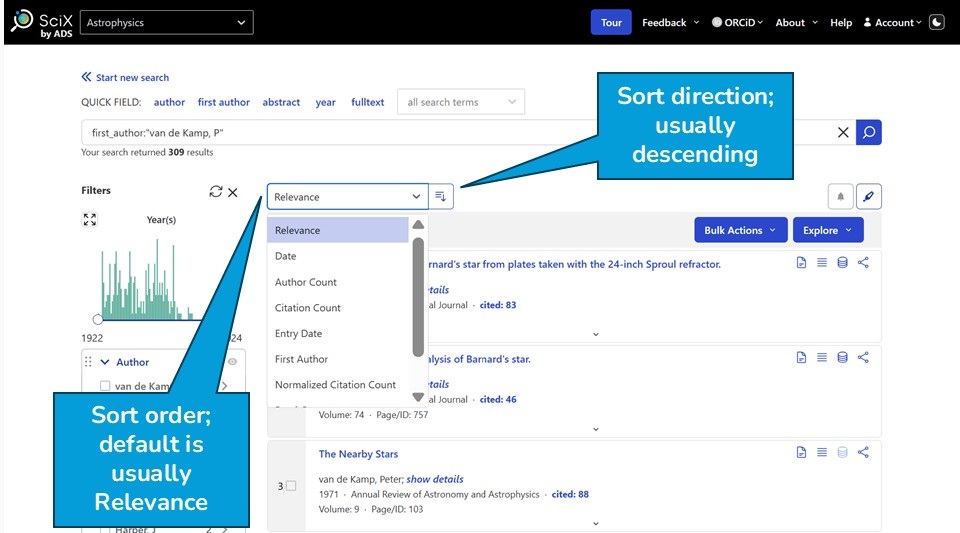
Author Count
This option sorts based on a record’s number of authors.
Citation Count
This option sorts based on a paper’s number of citations.
Credit Count
This option sorts based on a record’s number of credits.
Date
This option sorts based on a paper’s publication date (month and year).
Normalized Citation Count
This option sorts based on a paper’s normalized citation count, which is its total number of citations divided by its number of authors.
Entry Date
This option sorts based on a paper’s entry date in the SciX database.
First Author
This option sorts based on the last name of a paper’s first author.
Read Count
This option is a measure of recent popularity. It sorts on the 90-day read count of a paper: the number of times a paper has been accessed in SciX or on arXiv in the last 90 days.
Relevance
This option is usually the default sort in SciX, although ADS compatibility mode uses Date as its default sort order. Relevance sorts records based on a combination of four factors.
- The Lucene score from the search enginetakes into account how well a given result matches the search terms. Matches to certain fields are valued more highly than others; a match to an author name, for example, is weighted more highly than a match to a keyword. For unfielded searches, or those that do not use search tags, commonly searched fields, such as author and publication year, are more heavily weighted in determining the score (for example, see the weights within the “qf” parameter here).
- A popularity boost is applied to articles that are more highly cited or read. An age-normalized cite boost and recency boost are in development that will jointly replace this factor. (For more, see the cite_read_boost.)
- A document-type boost is applied so that articles are returned more highly than other documents, such as conference proceedings or books. (For details, see the DOCTYPE_BOOST_FACTORS.)
- A disciplinary boost is applied (defined as the COLLECTION_RANKINGS), so that results from collections more applicable to the selected discipline (in the top-left menu) are returned more highly. For example, if “Astrophysics” is selected, results from the astrophysics subcollection are weighted most, while articles from physics, general, planetary science, heliophysics, and earth science, in that order, are weighted with gradually decreasing boosts. (Astrophysics, planetary science, and heliophysics are developmental subcollections of the astronomy collection.)
Feedback regarding both well-ranked and poorly ranked results would be welcome.